



MEET LENA. She is a composite, not a real person, but every number in her story is real. She is 31, an engineer in Stuttgart, and she has written software that reads freight documents faster than any clerk. In Austin her first hire would be a second engineer. In Stuttgart it is somebody who understands forms.
She has reason to be careful. A German company spends 218 hours a year on its tax paperwork; a Swedish one spends 122. If her product touches data, artificial intelligence or cross-border sales, and it touches all three, she steps into a field of roughly 100 technology laws policed by more than 270 regulators across the EU. None of this is hostile. Each rule was written by a sensible person to prevent a real harm. That is the problem. Nobody ever added them up.
My argument in this article is simple, and it is an opinion, though one built on the EU's own numbers. Europe is not poor, stupid or lazy. It is slow by design, and it has mistaken the writing of rules for the making of progress.
The paper machine
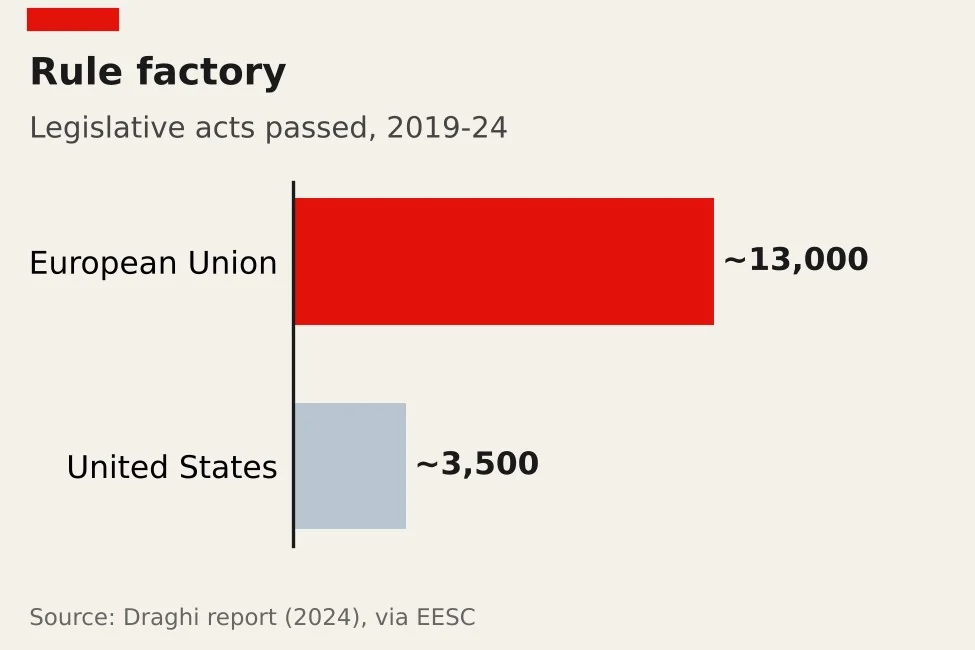
Start with volume. Between 2019 and 2024 the EU passed about 13,000 legislative acts. America's federal government passed about 3,500 over the same period (5,500 on a broader count). The man who published that comparison was no Eurosceptic. He was Mario Draghi, former head of the European Central Bank, writing at the request of the European Commission. His verdict on the tech rulebook: “We are killing our companies.”

Every binder was somebody's good idea
Roughly four acts in Brussels for each one in Washington
The detail is worse than the total. Draghi counted 16 new laws that oblige the textile industry alone to collect data. Germany's ifo Institute puts the price of the country's excess bureaucracy at up to €146bn a year in lost output, measured against what Germany would produce with Sweden's lighter touch.
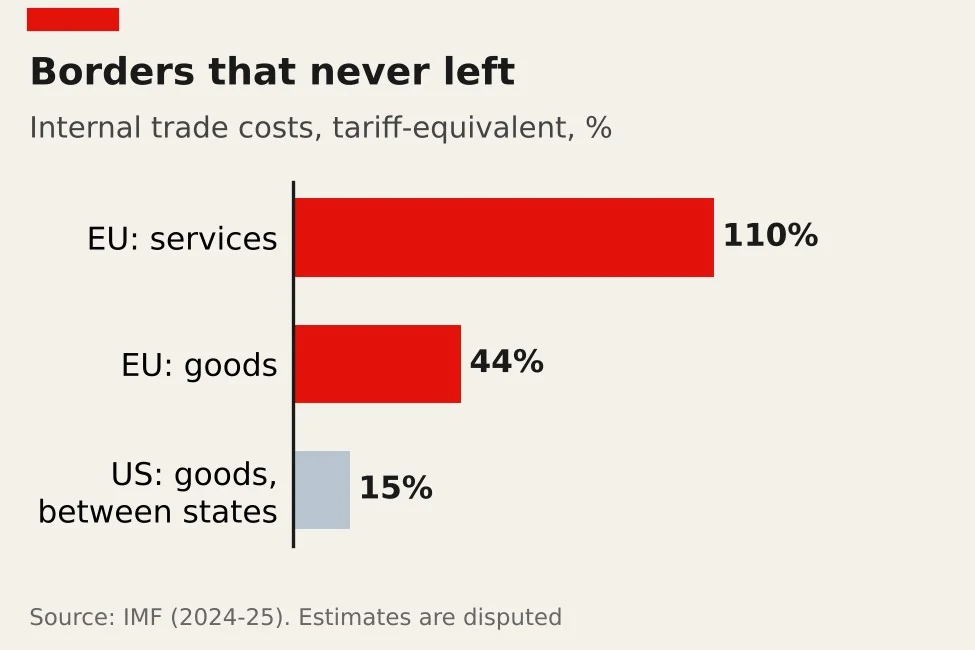
And the famous single market is not single. The IMF estimates that the barriers left inside it work like a tariff of 44% on goods and 110% on services; between American states the figure for goods is 15%. Some economists think those numbers are too high. Even at half the size, a Stuttgart founder selling to Lyon faces a steeper wall than a Texan selling to Ohio.
Twenty-seven markets wearing one flag
Eight years, eleven points of difference
What the paper costs
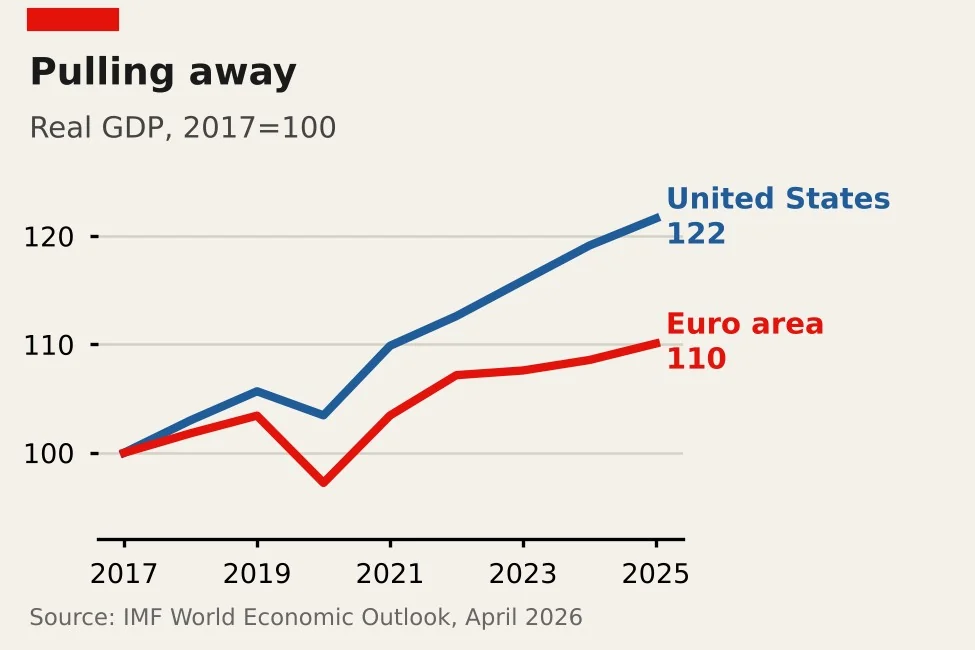
You can see the result in the growth figures. Since 2017 America's economy has grown by about 22%, the euro area's by about 10%. The gap is not a pandemic accident; it compounds a little every year. The scorecard below comes almost entirely from the Draghi report.
Europe's scorecard
| Measure | What the record shows |
|---|---|
| Productivity | EU output per hour was 95% of America's in 1995. It is now below 80% |
| Size of the gap | The EU-US gap in GDP doubled, from about 15% to 30%, between 2002 and 2023 |
| New giants | No EU company worth over €100bn has been built from scratch in 50 years. All six American firms worth over €1trn were |
| Tech leaders | Four of the world's 50 largest technology companies are European |
| Unicorn exodus | Nearly 30% of unicorns founded in Europe from 2008 to 2021 moved their headquarters abroad, most to America |
| Scale-ups | About 10% of EU scale-ups relocate. Around 85% of those choose the United States |
Read the last two rows again. Europe trains the engineers, funds the universities and pays for the early research. Then, at the moment a company becomes valuable, a third of the best ones leave. Talent is not dying in Europe. It is emigrating.
Dinosaurs in the boardroom
Artificial intelligence is where the habit becomes dangerous. Europe passed its AI Act in 2024, before it had an AI industry worth regulating. By November 2025 the Commission was proposing to delay its own high-risk rules, because the technical standards companies needed in order to comply did not exist. In May 2026 the delay was agreed: December 2027. The continent wrote the exam before anyone had written the textbook.

The agenda is thick. The lab next door is not waiting
Fourteen dollars in America for each one in Europe
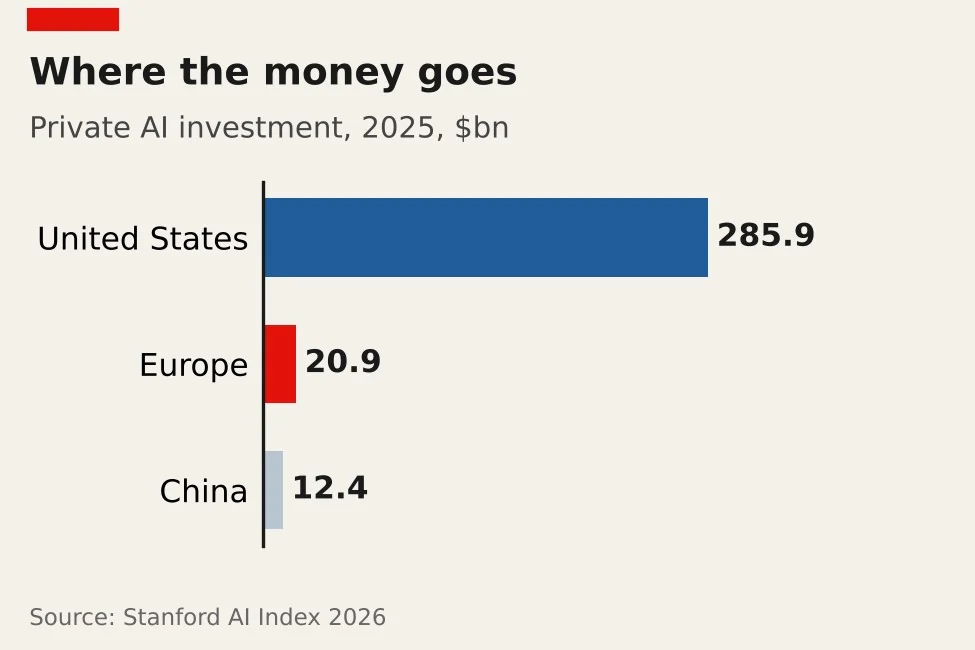
Meanwhile the money went elsewhere. In 2025 private investors put $285.9bn into AI in America and $20.9bn into the whole of Europe. China spent less still, $12.4bn, yet Stanford's AI Index finds its best models now trail America's by just 2.7%. China is no model of freedom. It is a model of speed: decide, build, correct later. Europe does the reverse. The EU's three biggest corporate spenders on research are still carmakers, as they were twenty years ago. That is what I mean by dinosaurs: large, impressive, and optimised for a climate that has already changed.
The island that was supposed to sink
In 2016 the British were told by almost every institution that mattered that leaving the EU would wreck them. Short-term forecasts spoke of immediate recession. A Cambridge study later described those forecasts as “overly pessimistic”. That is a polite way of saying wrong.

Dawn on the Thames: departure, not shipwreck
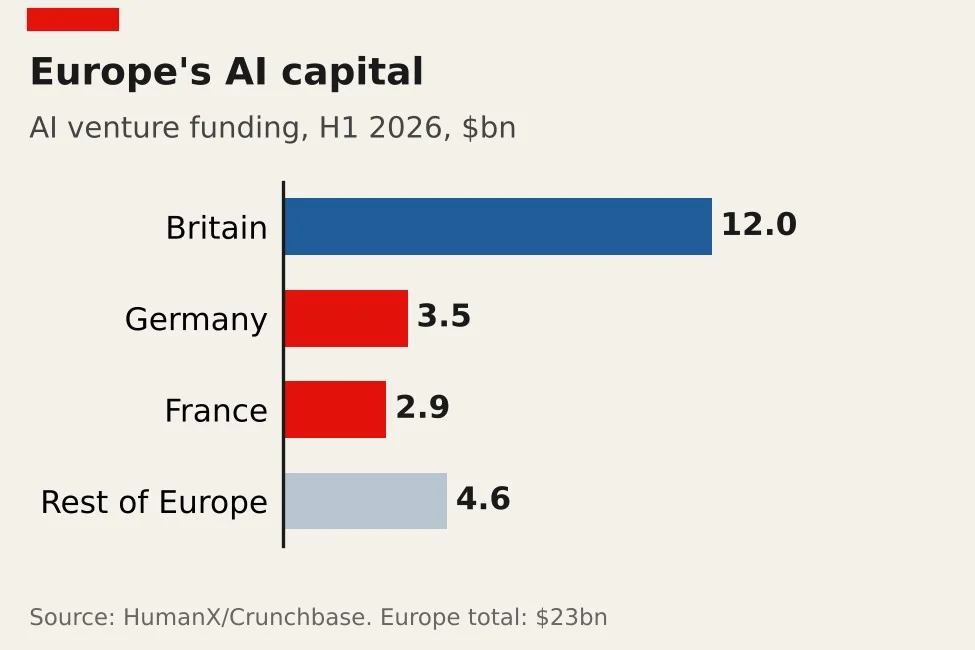
One country outside the EU raises more than the 27 inside it
Britain did not sink. By one widely quoted calculation its economy has grown by just over 8% since Brexit, level with France and ahead of Germany (5.5%) and Italy (5%). It is the world's second-largest exporter of services. Above all it has become Europe's AI capital: in the first half of 2026 British AI start-ups raised $12bn, more than half of everything raised in Europe, and London alone hosts some 1,700 venture-backed AI firms. Britain is not bound by the AI Act. It pays a 10% baseline tariff to sell into America where the EU pays 15%, and it signed a trade deal with India while Brussels was still negotiating.
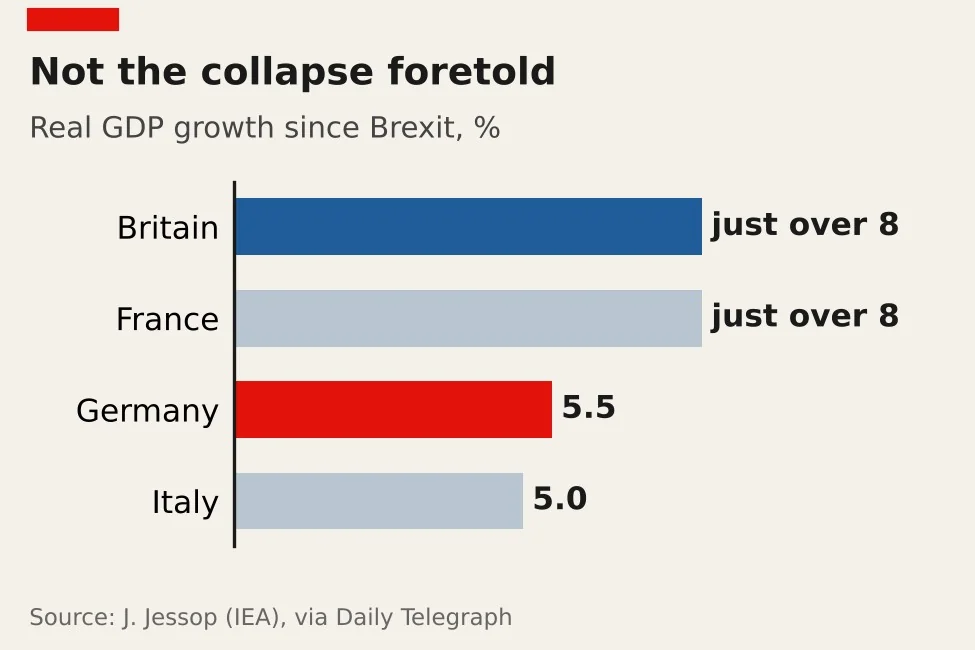
Level with France, ahead of Germany and Italy
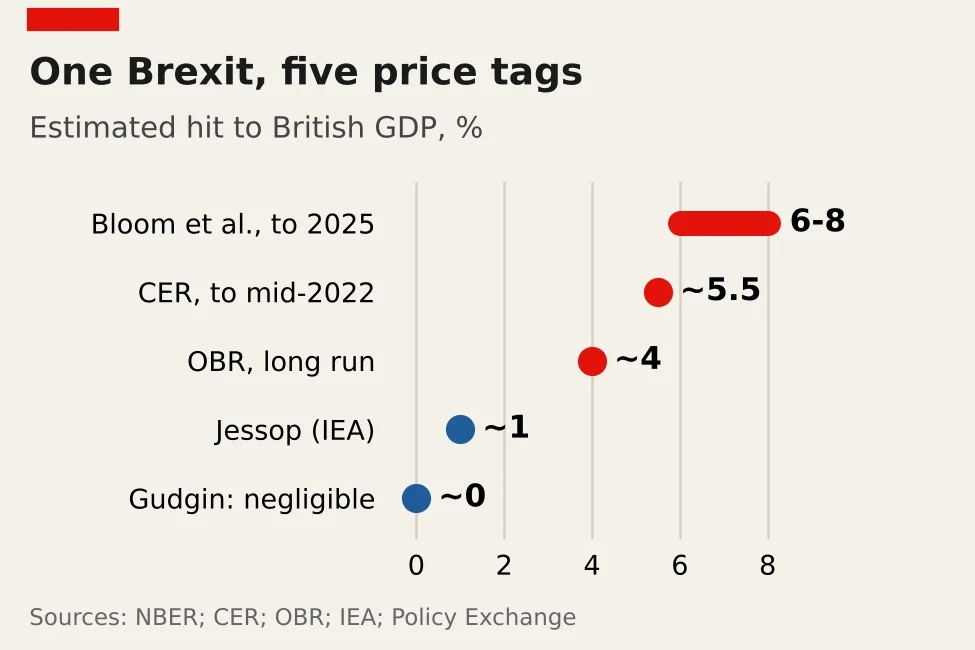
The same event, measured five ways
Honesty requires the other column. Several serious studies say Britain would be richer had it stayed: one puts the loss at 6-8% of GDP per head, the official budget watchdog assumes 4%, and critics of those models say 1% or nothing. Each estimate compares the real Britain with an imaginary one, so none can be proved. What can be measured is that goods exports have stagnated and that Britain has used only a fraction of its new freedom.
Brexit: the ledger so far
| What Britain gained | What it paid |
|---|---|
| No collapse; growth level with France, ahead of Germany and Italy | Model estimates of lost GDP from 1% to 8%, hotly disputed |
| Europe's largest AI and tech funding market, by a wide margin | Real goods exports about 1% below their 2016 level (to 2023) |
| Own trade policy: 10% US baseline tariff against the EU's 15%; India deal | New paperwork for selling to the EU; services exports an estimated 4-5% lower |
| Freedom to write its own rules on AI, finance and science | A freedom so far used cautiously |
My reading: Britain has not boomed, and against America it still looks small ($19.5bn of venture capital in half a year against $415bn). But it has kept pace with the EU's largest economies while regaining the right to change its own rules. For a country told to expect ruin, that is a result. The option to deregulate is worth more each year that AI accelerates.
What would fix it
Europe does not need to become Texas. It needs three things. First, a rule that every new regulation retires two old ones and expires unless renewed. Second, a single European company statute, so that Lena can incorporate once and sell in 27 countries. Third, a finished single market in services, capital and energy. Brussels has started: its simplification packages promise to cut the administrative burden by 25% by 2029. I will believe it when the hours fall.
Lena, meanwhile, has a decision to make. An investor in San Francisco has offered to fund her, on one condition: that the company moves. She loves Stuttgart. She will probably go. Multiply her by a few thousand and you have Europe's real export.

Europe's most valuable export leaves one founder at a time
Sources
M. Draghi, The Future of European Competitiveness (European Commission, 2024), as summarised by the EESC, CEPA, PYMNTS, Semafor, The Next Web and Legal Dive. ifo Institute, press release of 14 Nov 2024 (bureaucracy costs; tax hours via Haufe). IMF, working paper WP/25/113 and Finance & Development, June 2025 (internal barriers); critique by L. Bini Smaghi, Bocconi IEP, July 2025. IMF World Economic Outlook, April 2026 (GDP index, author's calculation from annual growth rates). EIB, relocation of EU start-ups and scale-ups (2025). Stanford HAI, AI Index Report 2026. HumanX/Crunchbase, H1 2026 (AI venture funding). Dealroom/Prosus, State of AI in Europe 2026. PitchBook via TechRepublic, Sept 2026. Orrick and Taylor Wessing on the Digital Omnibus on AI, May 2026; Pinsent Masons on the 25% target. Coutts, Gudgin and Buchanan, Cambridge CBR working paper 493 (2018). J. Jessop (IEA) via Daily Telegraph (growth since Brexit; period as defined by the source). UK Department for Business and Trade, Brexit fourth-anniversary paper (2024). Resolution Foundation, Trading Blows (2024). Bloom et al., NBER working paper 34459 (2025). OBR Brexit analysis, March 2026. CER, The cost of Brexit to June 2022 and follow-up. LSE CEP discussion paper 2110 (2025) and LSE blog, June 2024 (trade). Reuters via The Citizen, and ICAEW (tariffs, India). Lena is an illustrative composite; the pictures are AI-generated illustrations.