

Abstract
Bosch, the world's largest automotive supplier, is in its deepest crisis since the 2009 financial crash. Sales have stalled at about EUR 91 billion since 2023. The operating EBIT margin fell from 5.3% in 2023 to 2.0% in 2025, and the group posted a net loss of about EUR 400 million, its first since 2009.
This paper examines Bosch's published results from 2020 to the first half of 2026. It finds that the decline is structural, not cyclical. Five drivers explain it: a delayed electric-vehicle ramp-up, Chinese price competition, a high-cost German production base, weak software execution and trade barriers. Some 22,000 job cuts in Germany by 2030 are the company's main response.
The evidence does not support a collapse in the literal sense. Bosch stays solvent, foundation-owned and cash-positive. The more accurate diagnosis is a slow loss of competitiveness in its core business, which the company itself admits.
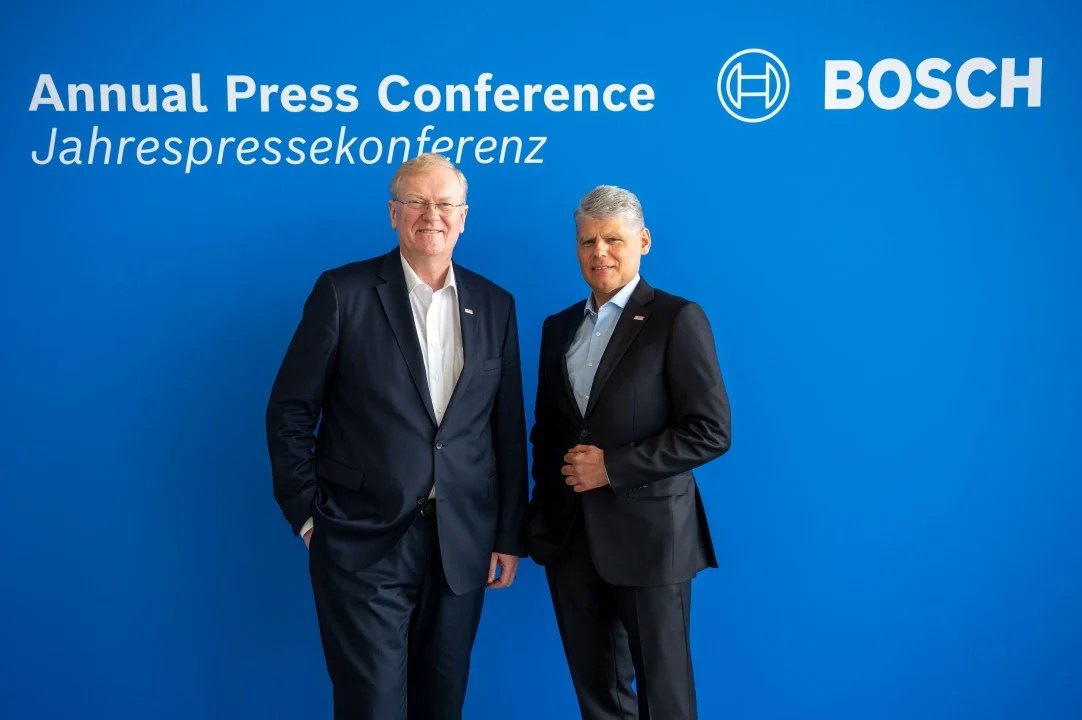
Figure 1. Bosch's annual press conference, where the group reports its yearly results. Picture: Bosch
1. Introduction and method
The research question is simple: is Bosch in decline, and if so, why? Bosch matters beyond its own size. It employs about 413,000 people worldwide, around 123,000 of them in Germany, and it is the industrial anchor of the Stuttgart region.
The working hypothesis is that Bosch's problems are structural. A cyclical downturn would show falling sales and recovering margins as volumes return. A structural decline shows something else: stable sales, shrinking profitability and repeated cost programmes that fail to close the gap.
The analysis uses three kinds of evidence:
Financial data from Bosch's annual reports and press releases, 2020 to the first half of 2026: sales, operating EBIT margin, net result and free cash flow.
Segment data for the Mobility business sector, which delivers about 61% of group sales.
Restructuring data: announced job cuts, impairments and management statements, cross-checked against Eurofound's restructuring records and business press reporting.
All figures are in euros as Bosch reports them. "EBIT margin" means EBIT from operations as a share of sales, Bosch's own headline measure. Calendar year and fiscal year are the same at Bosch.
2. Financial trajectory 2020–2026
Bosch's revenue has not shrunk; its profit has. Sales recovered from the pandemic to EUR 91.6 billion in 2023 and have stayed at that level since. Over the same two years the operating margin lost more than half its value.
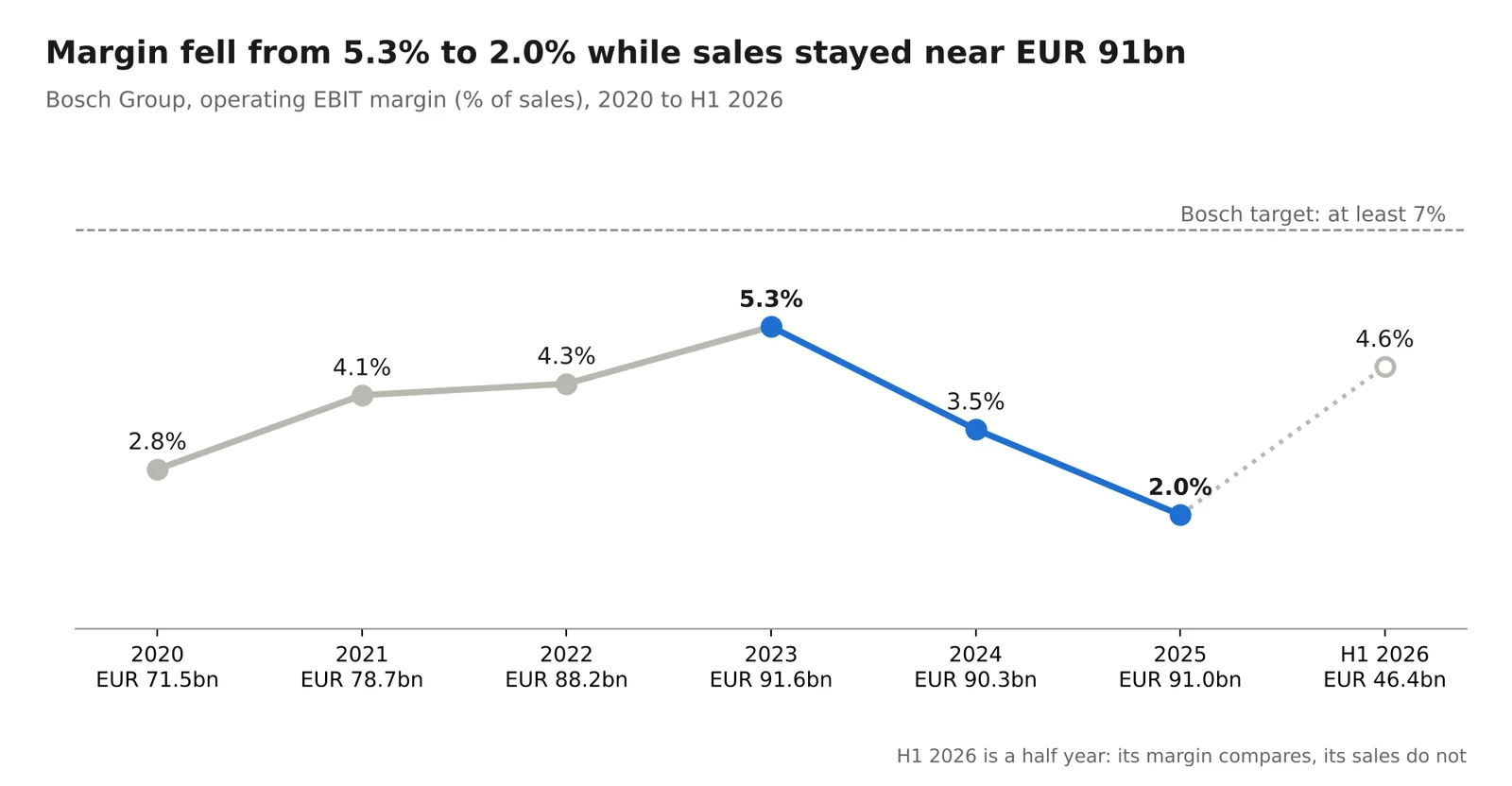
Figure 2. Bosch Group operating EBIT margin and sales, 2020 to H1 2026. Source: Bosch annual reports and press releases.
Three numbers show how serious 2025 was. Bosch booked EUR 2.7 billion of provisions for restructuring and job cuts. Free cash flow fell to about EUR 0.3 billion, from EUR 0.9 billion in 2024. And the group made a net loss of about EUR 400 million, its first since 2009.
The pattern matters for the hypothesis. In a cyclical downturn, sales drop first and margins follow. At Bosch, sales held while margins fell, which points to price pressure and a cost base that no longer fits the business.
3. Mobility, the core of the problem
Mobility is where Bosch is losing. The sector brought in EUR 55.8 billion in 2025, about 61% of group sales, almost exactly what it earned in 2023. Its operating margin, however, fell from 4.4% to 1.8% in two years.
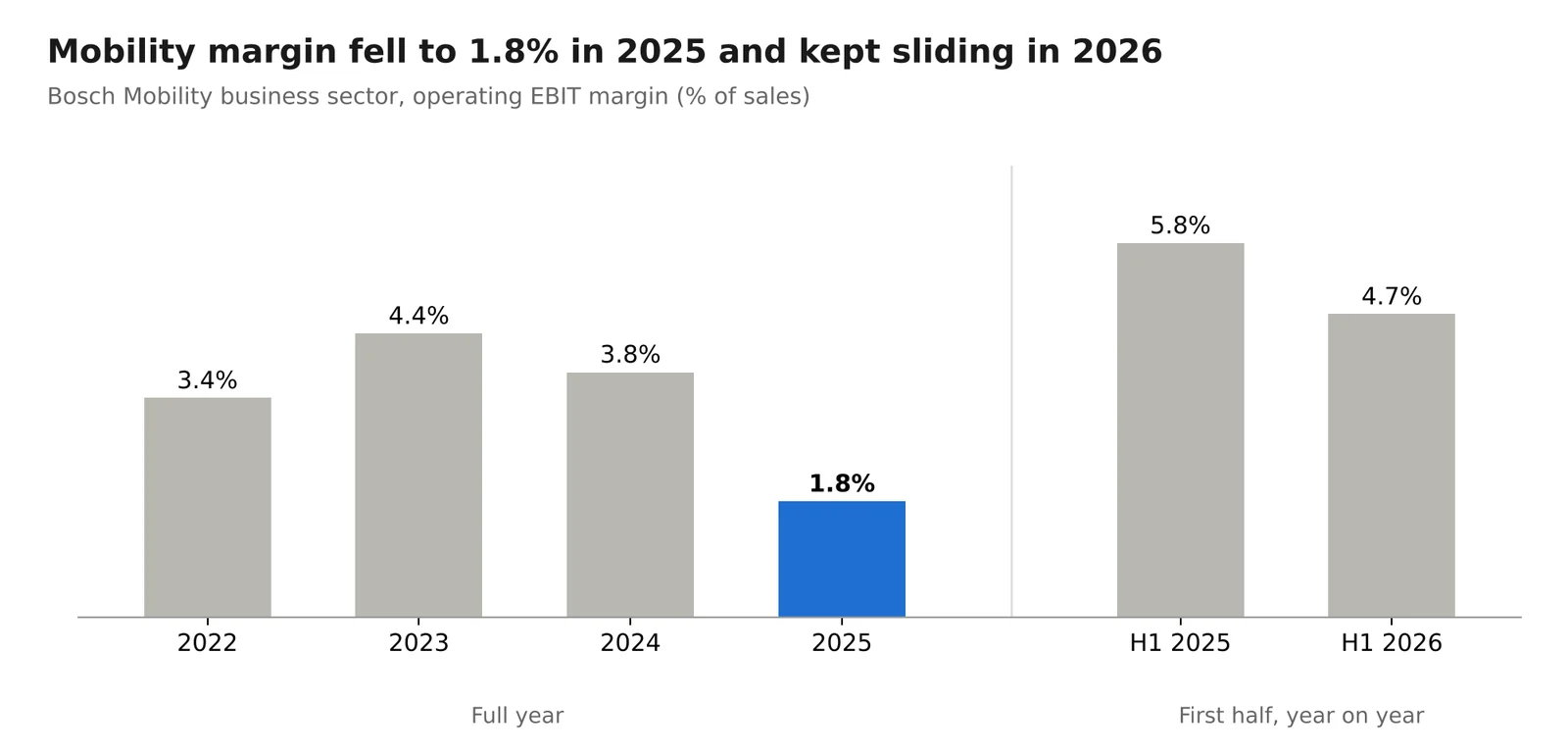
Figure 3. Bosch Mobility operating EBIT margin, 2022 to H1 2026. Source: Bosch press releases, Gasgoo.
The decline continued in 2026. Mobility sales slipped 0.5% in the first half, and the margin fell from 5.8% to 4.7%. Bosch wrote down EUR 270 million on production plants because, in its own words, the global ramp-up of electric mobility is lagging behind expectations.
This is the heart of the problem. Bosch invested heavily in EV drives, hydrogen fuel cells and automated driving. Those markets grew slower than planned, while the old diesel and combustion business that funded them is shrinking. Bosch now carries capacity for both worlds and earns too little in either.
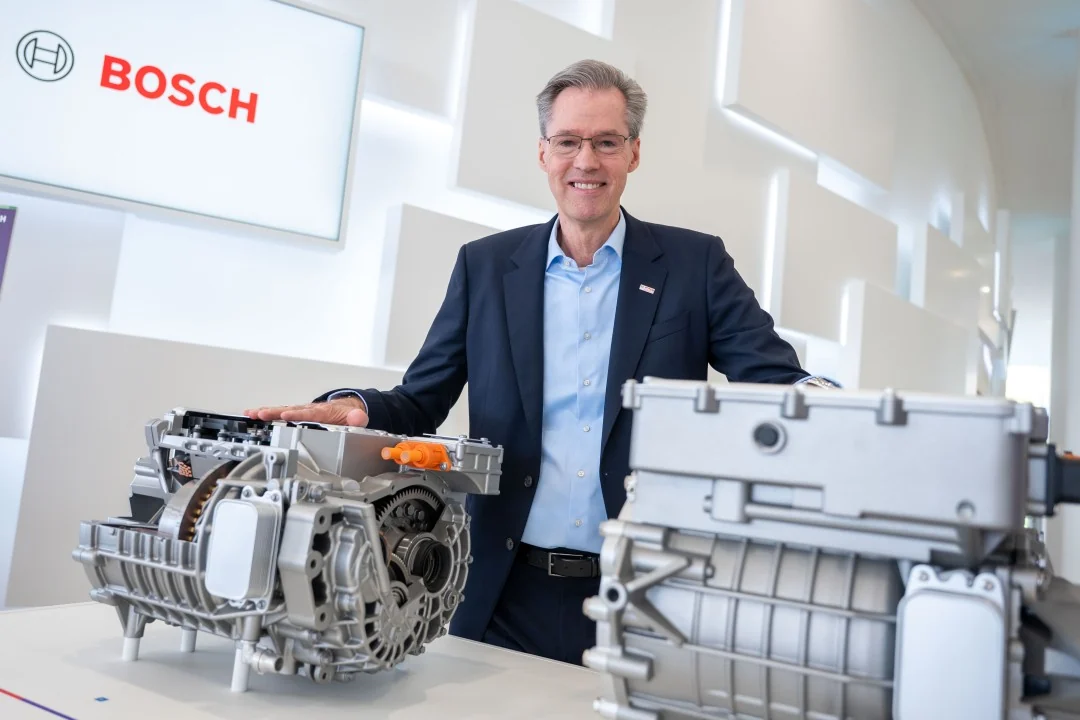
Figure 4. Bosch electric drive units: the EV business grew slower than Bosch had planned. Picture: Bosch
4. Workforce restructuring
Bosch is answering the margin problem mainly with job cuts. In 2024 it announced about 9,000 cuts, mostly in Mobility. In September 2025 it added 13,000 more, bringing the total to around 22,000 by the end of 2030.
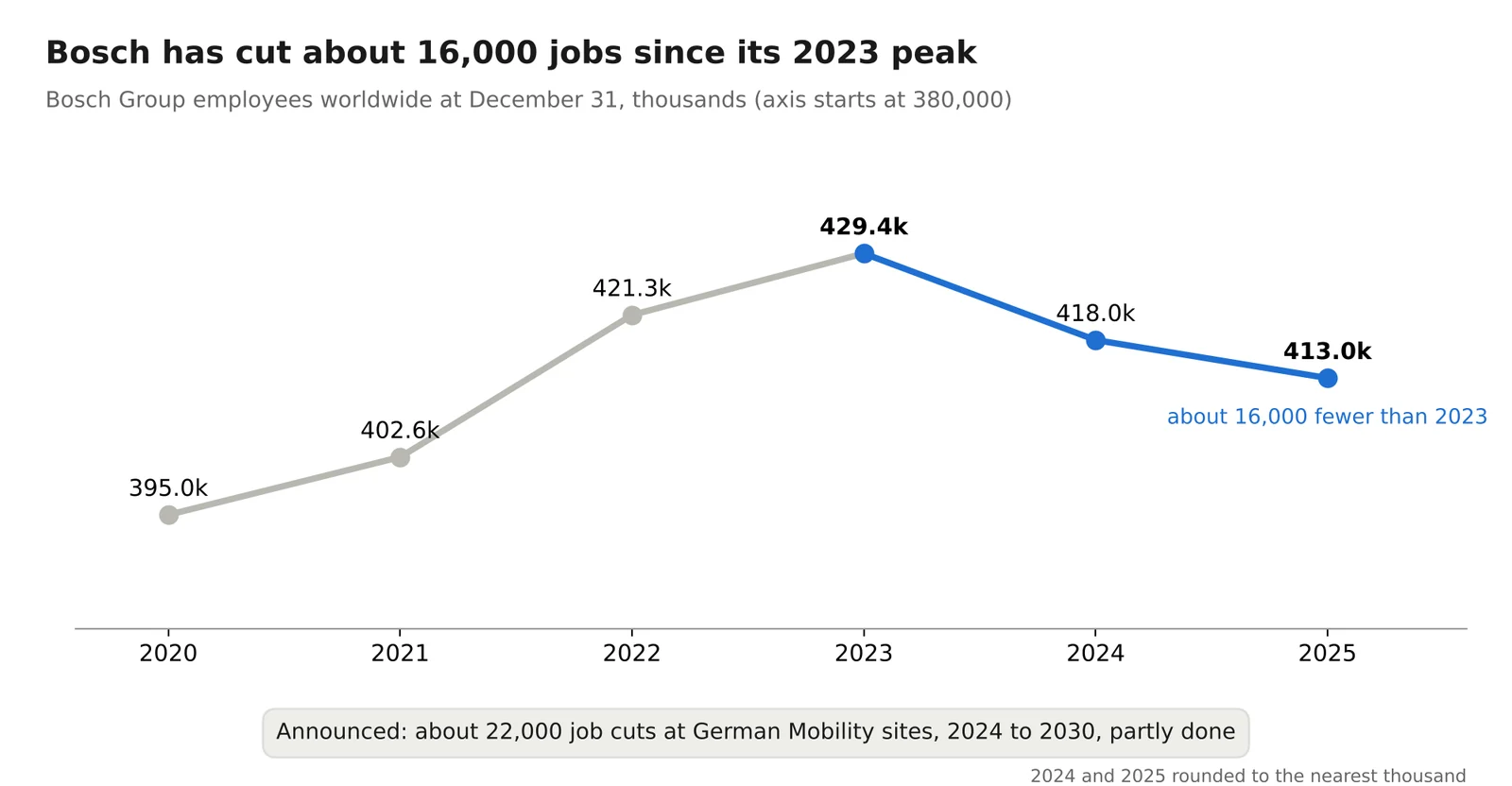
Figure 5. Bosch Group employees worldwide, 2020–2025, and announced cuts. Source: Bosch key data, Eurofound, electrive.
The cuts are concentrated at home. The second wave alone removes about 10% of Bosch's German workforce, and Mobility employed roughly 70,000 people in Germany before it. Stuttgart-Feuerbach loses about 3,500 jobs, 1,500 of them in diesel powertrain components. Bosch's German headcount fell to about 123,000 in 2025, down 5% in a year.
Bosch justified the second wave with a cost gap of about EUR 2.5 billion a year in Mobility. Workers' representatives called the scale of the cuts unprecedented and accused Bosch of damaging whole regions. The first half of 2026 brought another 6,500 job losses worldwide, around 4,000 of them in Germany.
5. Root causes: five structural drivers
No single shock explains the decline. Five forces act at once, and each one would be manageable alone. Together they hit the same business, Mobility, at the same time.
The drivers reinforce each other. Late EV demand leaves German plants underused just as Chinese rivals cut prices. Tariffs and local-production demands then pull new orders away from those same plants. Bosch itself has described the result plainly: in many areas the company is no longer competitive.
The fourth driver deserves attention because it hurts the future, not just the present. Bosch's strategy depends on software-defined vehicles, automated driving and hydrogen. When Volkswagen dropped the automated-driving partnership, reportedly over doubts about the technology's global competitiveness, it hit the very area meant to replace the shrinking combustion business.
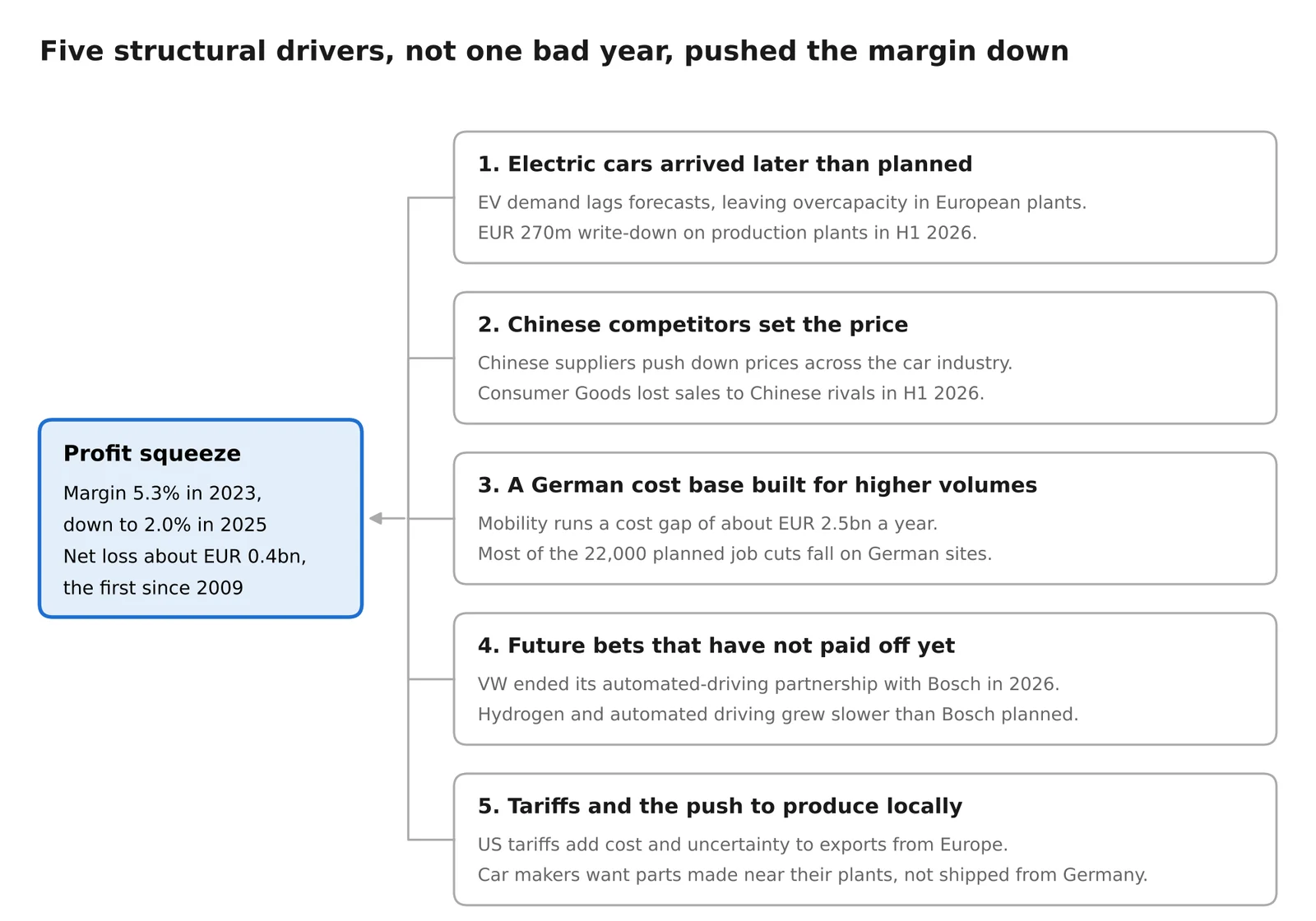
Figure 6. Driver tree: five causes of the 2023–2025 profit squeeze.
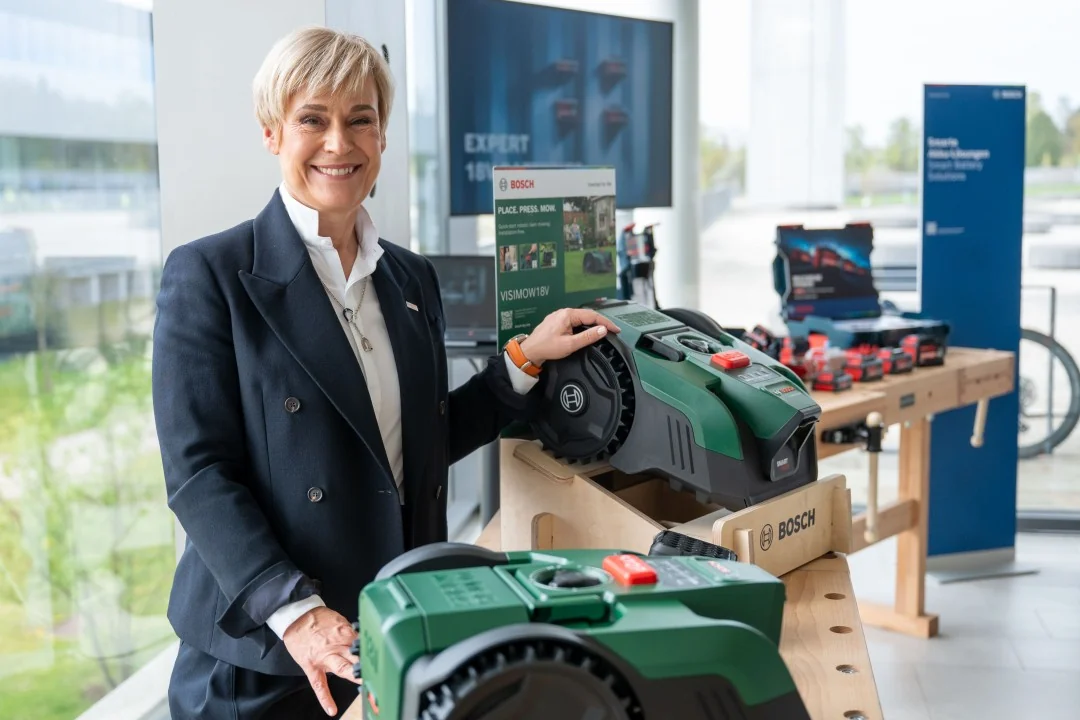
Figure 7. Power tools and garden products from Consumer Goods, a sector now under pressure from Chinese rivals. Picture: Bosch
6. Governance: the foundation model under strain
Bosch's ownership is unusual. Since 1964 the group has been held under a trust-foundation structure: the Robert Bosch Stiftung owns most of the shares, while voting control sits with Robert Bosch Industrietreuhand KG. The founding family keeps a small stake.
This model has two sides in a crisis:
Strength: no stock-market pressure, no takeover risk and a mandate to protect long-term financial independence. Bosch can keep R&D near 8.7% of sales even in a loss year.
Weakness: no outside shareholders force speed. Margin targets have slipped year after year without a market penalty. The 7% target was due by 2026; in early 2026 it was pushed to 2027 at the earliest.
The leadership change in mid-2026 is a telling signal. CEO Stefan Hartung stepped down on June 30, 2026, only months after his contract had been extended to 2031. He left the Industrietreuhand too. Deputy CEO Christian Fischer took over on July 1. According to Handelsblatt, no previous Bosch CEO served a shorter term, and Hartung was only the seventh CEO in 140 years.
The official reason was Hartung's wish to pursue other commitments. Bosch framed Fischer's appointment as continuity, since he helped shape Strategy 2030. Even so, an early exit in a company built on stable leadership points to pressure at the top.
7. Collapse or correction? Outlook 2026–2027
The first half of 2026 shows stabilisation, not recovery. Sales rose 3.6% to EUR 46.4 billion, but mostly because of the acquired Johnson Controls-Hitachi heating and cooling business. Operating EBIT slipped from EUR 2.3 billion to EUR 2.2 billion, and the margin fell from 5.1% to 4.6%.
The arguments against a collapse are strong:
Bosch is still profitable at the operating level, with a net result of about EUR 1.1 billion in the first half of 2026.
Free cash flow stayed positive in 2025, at about EUR 0.3 billion.
Its 2024 equity ratio of 44.3% is high for an industrial group.
Diversification helps: Energy and Building Technology lifted its margin from 0.8% to 7.3% in the first half of 2026.
The arguments for continued decline are just as clear:
Mobility, the biggest sector, keeps losing margin, and in 2026 it took EUR 270 million of new impairments on EV-related plants.
Consumer Goods lost sales to Chinese competitors in the first half of 2026.
Bosch has stayed below its 7% margin target in every year since 2020.
For the first time, Bosch published half-year accounts so it can tap bond markets more easily. A self-financing foundation company looking for outside capital is a cultural break.
Bosch's own guidance for 2026 is 2–5% sales growth and a 4–6% operating margin. Even the top of that range stays below the 7% Bosch says it needs to fund its future.

Figure 8. Bosch presents new business fields such as a smart anaemia screening solution, part of its push to diversify. Picture: Bosch
8. Conclusion
Bosch is going down, but slowly and not to the point of collapse. The data shows a classic structural decline: flat sales, a margin that more than halved in two years, and a cost gap the company itself puts at EUR 2.5 billion a year in Mobility alone.
The root problem is that Bosch built capacity in Germany for a future that arrived late and arrived cheaper. Electric cars came slower than planned, Chinese suppliers came faster, and software partnerships did not deliver. Job cuts can close the cost gap. They cannot by themselves restore the technology lead that once justified Bosch's prices.
The next two years decide which story holds. If the 2026 cost cuts lift the margin towards 7% by 2027, this will read as a painful correction. If Mobility margins keep falling, Bosch risks becoming a large, safe and slowly shrinking supplier. For Baden-Württemberg, that second outcome would be the real crisis.

Figure 9. Concept image: robotics and AI are among the bets Bosch hopes will drive its next phase of growth. Picture: Bosch
References
Robert Bosch GmbH (2026). Annual financial results 2025, press release. https://www.bosch-presse.de/pressportal/us/en/press-release-30336.html
Robert Bosch GmbH (2025). Key data for the 2024 business year. https://bosch-presse.de/pressportal/de/media/asset/jag2025_externe_kenndaten_2024_en_final_ohnesperrfrist.pdf
Robert Bosch GmbH (2025). Geschäftsbericht 2024. https://www.lobbyregister.bundestag.de/media/9b/a4/546230/Bosch_Geschaeftsbericht_2024.pdf
Robert Bosch GmbH (2024). Key data of the 2023 business year. https://bosch-presse.de/pressportal/de/en/key-data-of-the-2023-business-year-264539.html
Robert Bosch GmbH (2022). Annual report 2021. https://uploads2.craft.co/uploads/craft/source/document/8038/66ef37548f20cce6.pdf
Robert Bosch GmbH (2021). Business year 2020 infographic. https://www.bosch-presse.de/pressportal/de/en/news/infographic/
Robert Bosch GmbH (2026). Changes on the board of management. https://www.bosch-presse.de/pressportal/de/en/changes-on-the-robert-bosch-gmbh-board-of-management-283584.html
Eurofound (2025). Restructuring event: Bosch, 13,000 job cuts. https://apps.eurofound.europa.eu/restructuring-events/detail/203527
electrive (2025). Bosch to cut another 13,000 jobs in its mobility division. https://www.electrive.com/2025/09/25/bosch-plans-to-cut-another-13000-jobs-in-its-mobility-division
electrive (2026). Bosch CEO Stefan Hartung steps down unexpectedly. https://www.electrive.com/2026/06/26/bosch-ceo-stefan-hartung-steps-down-unexpectedly/
AutoInformed (2026). Bosch Group plans sales, EBIT growth after a so-so 2025. https://autoinformed.com/?p=102849
Gasgoo (2026). Bosch first-half 2026 sales reach 46.4 billion euros. https://autonews.gasgoo.com/articles/market-industry/bosch-first-half-2026-sales-reach-464-billion-euros-maintains-full-year-forecast-2103045222451068928
Reuters via Euronext (2026). Bosch profit margin slips, pressured by weak car production. https://live.euronext.com/en/financial-news/bosch-profit-margin-slips-pressured-weak-car-production-one-charges
Börsen-Zeitung (2026). Bosch schreibt 2026 bereits ab. https://www.boersen-zeitung.de/unternehmen-branchen/ergebnis-von-bosch-bricht-um-fast-die-haelfte-ein
Stuttgarter Zeitung (2026). Bosch rutscht erstmals seit der Finanzkrise in die roten Zahlen. https://www.stuttgarter-zeitung.de/wirtschaft/stellenabbau-kostet-milliarden-bosch-rutscht-erstmals-seit-der-finanzkrise-in-die-roten-zahlen-78826376.html
just-auto (2026). Bosch CEO steps down. https://www.just-auto.com/?p=194839
Stewards (n.d.). Bosch: trust-foundation ownership. https://stewards.gr/case-studies/bosch/