

What the AfD actually stands for economically — and why the institutions that forecast Germany's economy keep warning that its rise would cost the country dearly.
Magdeburg & Berlin — September 2026
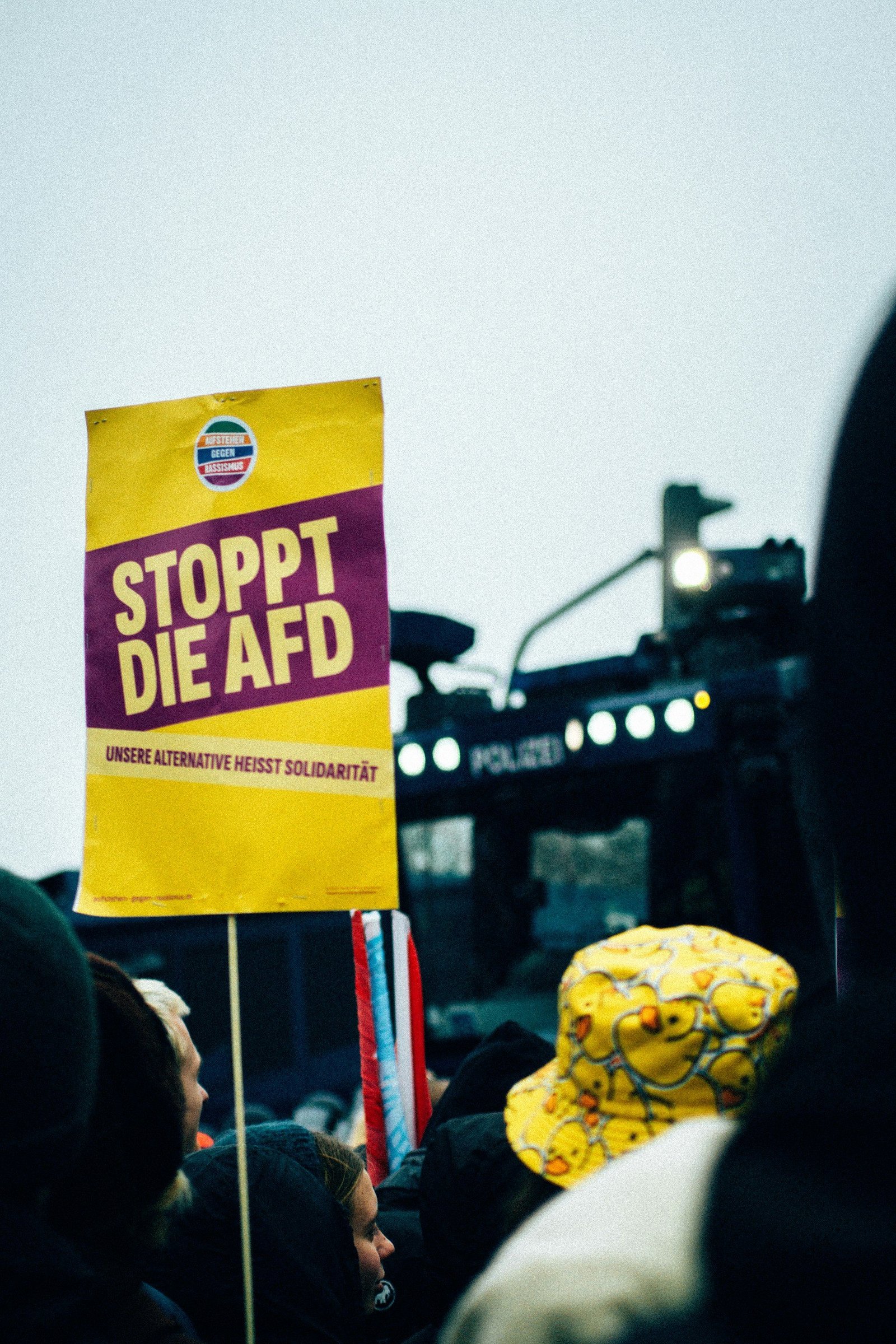
On the night of September 6, 2026, the count in Saxony-Anhalt stopped being a regional curiosity. The Alternative for Germany took 43.8 percent of the vote — short of an outright majority, but larger than any single party has managed in a German state election in the post-war era. Ulrich Siegmund, the local AfD leader, stood in front of supporters in Magdeburg and promised an "economic boom" for the state. A few kilometers away, in Berlin, Chancellor Friedrich Merz's party spent the next morning ruling out any coalition with the AfD — the so-called Brandmauer, or "firewall," that every mainstream German party has maintained since the AfD's founding in 2013. Meanwhile, at the Halle Institute for Economic Research, economists were finishing a rather less triumphant assessment: that the AfD's own platform, if implemented, would deepen the very labor shortage the state cannot afford and could cost Saxony-Anhalt billions in lost output.
That gap — between the story the AfD tells about the economy and the story its critics' models tell — is the subject of this piece. It is worth taking seriously, because the gap will not stay theoretical much longer. The AfD is now the country's most popular party in national polling, at roughly 28 percent, ahead of Merz's CDU/CSU at around 20 percent. It has already won a German state outright. With the next federal election due in 2029, every regional win now doubles as a rehearsal.
Who They Are and What They Actually Propose
The AfD did not start out as the party it is today. It was founded in 2013 by a group of economics professors, led by Bernd Lucke, in protest at German-funded bailouts during the Eurozone debt crisis. Its original ask was narrow and technical: let weaker economies leave the euro, or let Germany do so itself. The 2015 refugee crisis transformed the party into something broader and considerably more radical, and it has kept moving in that direction since — its domestic intelligence service now classifies significant parts of it as a confirmed or suspected right-wing extremist organization. But the economic program built in 2013 never went away; it now sits alongside, and is increasingly shaped by, the party's positions on migration and climate.
| Area | Position |
|---|---|
| Migration | Large-scale deportation of irregular migrants and rejected asylum seekers ("remigration"), tighter borders, and a sharp reduction in labor migration from outside Europe. |
| Energy & climate | Halting further wind and solar buildout, scaling back the Energiewende (Germany's renewable transition), and reviving fossil fuels — openly skeptical of mainstream climate policy. |
| Europe & the euro | Describes the EU as a "failed project," has praised Brexit as a model, and its leadership — including co-chair Alice Weidel — has declined to rule out Germany leaving the EU and the euro, a scenario party members call "Dexit." |
| Taxes & the state | Lower taxes, less bureaucracy, and a smaller regulatory footprint for business — paired with continued defense of Germany's constitutional "debt brake," even as the party pushes for higher spending in areas it favors. |
Two things about this platform matter for what follows. First, it has never been implemented anywhere, at any level of German government — the firewall has kept the AfD out of every governing coalition so far, so every claim about its economic effects, in either direction, is necessarily a forecast rather than a track record. Second, a state government would only ever get to test part of it: a German Land does not set national tax rates, cannot leave the EU, and does not control immigration law. Saxony-Anhalt, in other words, would be a partial trial at best.
A decade of gains — AfD vote share, federal elections and current national polling
| Year | AfD vote share |
|---|---|
| 2013 | 4.7% |
| 2017 | 12.6% |
| 2021 | 10.4% |
| 2025 | 20.8% |
| 2026 (poll) | 28% |
The AfD failed to enter the Bundestag in 2013 (4.7%, below the 5% threshold), broke through in 2017, dipped slightly in 2021, then doubled its vote share in the 2025 federal election to become the country's second-strongest party. National polling in 2026 puts it in first place. Source: Federal Returning Officer election results; INSA polling, 2026.
The Labor Market: A Shortage the AfD's Own Base Is Voting to Worsen
Germany's core economic problem right now has little to do with ideology: its workforce is aging and shrinking, and the country has spent a decade partly offsetting that with immigration. The ifo Institute's autumn 2026 forecast expects unemployment to average 6.3 percent this year, easing only slowly as demographic decline and weak productivity growth cap how fast the economy can expand. Eastern states like Saxony-Anhalt face this most acutely: the state's population, already reduced sharply since reunification, is projected to shrink by a further 15 percent by 2040.
Against that backdrop, the Halle Institute for Economic Research (IWH) has warned specifically that the AfD's anti-immigration program would deepen Saxony-Anhalt's labor shortage and could cost the state billions in economic output — precisely because deportations and reduced labor migration remove workers from an economy that is already short of them. Merz has separately argued an AfD state government would deter foreign investment altogether, since companies weigh political risk and workforce availability together when deciding where to build.
- 6.3% — forecast average unemployment rate, Germany, 2026 (ifo Institute)
- 15% — projected Saxony-Anhalt population decline, 2022–2040
- 43.8% — AfD vote share, Saxony-Anhalt state election, Sept. 2026
Energy: Unwinding the Thing the East Already Built
The irony of the AfD's energy platform is sharpest in exactly the region where the party performs best. Wind and solar power now generate more than 60 percent of Saxony-Anhalt's electricity — the product of two decades of buildout and investment that the AfD wants to halt and partly reverse, in favor of a return to fossil generation. Economists' objections here are less about ideology than about sunk cost and stranded assets: reversing course after the infrastructure, jobs, and supply chains are already in place destroys value that a simple "don't build more" policy would not, and unsettles investors who had priced in the current trajectory of German energy policy.
Where the AfD has already won — regional election results, eastern German states, 2024–2026
| State | Year | AfD vote share |
|---|---|---|
| Thuringia | 2024 | 33% |
| Saxony | 2024 | 30% |
| Brandenburg | 2024 | 29% |
| Saxony-Anhalt | 2026 | 43.8% |
The AfD topped the poll in Thuringia in 2024 and finished a close second in Saxony and Brandenburg the same year. In September 2026 it won an outright plurality in Saxony-Anhalt — its strongest result yet in any German state election. Source: state election authorities, 2024–2026.
"Dexit": The Scenario That Alarms Economists Most
Of all the AfD's positions, the one that most worries mainstream economists is the least likely to happen soon and the most damaging if it ever did: leaving the euro and, potentially, the EU itself. The party has not committed to this outright, but its leadership has repeatedly declined to rule it out. Because Germany's economy is built around the euro — its export contracts, its banks' balance sheets, its role as the currency's anchor economy — analysts who have modeled an exit describe the potential fallout in terms usually reserved for financial crises rather than policy shifts.
Estimates vary by method and time horizon, which is itself informative: nobody who has actually modeled this scenario thinks it would be mild. Berenberg Bank's chief economist, Holger Schmieding, has put the cost above 10 percent of German output within a decade. The German Economic Institute (IW Cologne) models a faster, sharper hit: 5.6 percent of real GDP within five years, alongside an estimated 2.5 million jobs lost. ING's global macro head, Carsten Brzeski, has gone further still, warning of financial-institution stress and a sharp rise in public debt in a genuine exit scenario.
Modeling a euro exit — estimated GDP impact of "Dexit," by institution and time horizon
| Institution | Horizon | Estimated GDP impact |
|---|---|---|
| Berenberg Bank | 10 years | more than 10% |
| IW Cologne | 5 years | 5.6% (plus roughly 2.5 million jobs lost) |
The two estimates use different methods and different horizons, so they should be read as independent, not averaged. Berenberg models output lost over ten years; IW Cologne models a faster five-year hit and additionally estimates roughly 2.5 million jobs lost. Neither institute has published a single "consensus" figure, which reflects how unprecedented the scenario is. Source: Berenberg Bank; IW Cologne, Analysis of Party Economic Programmes, April 2026.
Nobody who has actually modeled a German exit from the euro thinks it would be mild — they disagree only on how large the damage would be, and how fast it would arrive.
The Fiscal Contradiction at the Center of the Platform
There is a tension inside the AfD's own economic program that gets less attention than migration or energy, but that professional economists flag repeatedly: the party has positioned itself as the strictest defender of Germany's constitutional "debt brake," even after 2025, when a separate constitutional majority exempted defense spending from that same restriction and created an infrastructure fund alongside it. A party that wants to cut taxes, increase spending on its own priorities, and simultaneously hold the line on borrowing is describing three things that are difficult to do together — a contradiction that has not yet been tested against a real budget, because the AfD has never held one.
That test is closer than it used to be. Germany's broader fiscal picture is already stretching: the ifo Institute's autumn 2026 forecast expects the federal budget deficit to widen from 3.0 percent of GDP in 2025 to 4.6 percent by 2028, with gross public debt rising from 62.7 to 67.9 percent of GDP over the same period — driven mainly by increased defense and infrastructure spending under the current government, not the AfD. Whoever governs Germany over the next few years inherits less fiscal room than the country has had in decades, which makes the AfD's promise of tax cuts without new revenue sources harder to reconcile with its promise of fiscal discipline.
The economy the next government inherits — ifo Institute autumn 2026 forecast, Germany
| Indicator | 2025 | 2028 |
|---|---|---|
| Federal budget deficit (% of GDP) | 3.0% | 4.6% |
| Gross public debt (% of GDP) | 62.7% | 67.9% |
Real GDP growth is expected to slow through 2028 as the current recovery fades and demographic labor constraints reassert themselves. Public debt is shown for the two years ifo explicitly reports (2025 and 2028) rather than interpolated in between. This is the baseline trajectory any governing party — AfD included — would be working against. Source: ifo Economic Forecast, Autumn 2026.
The Other Side of the Ledger
None of this is uncontested, and it would be misleading to present it as settled. The AfD's own account of its economic program is the mirror image of the institutional warnings above: lower taxes and lighter regulation, in its telling, unlock investment that current policy suppresses; cheaper, fossil-heavy energy lowers costs for the energy-intensive manufacturers that dominate eastern German industry; and a smaller, less immigration-dependent labor market forces productivity gains rather than relying on population growth. Siegmund's promise of an "economic boom" in Saxony-Anhalt is the clearest public statement of that logic, not a slip of the tongue.
It is also true that the institutions cited throughout this piece — ifo, IW Cologne, the Halle Institute, Berenberg, ING — are mainstream economic research organizations whose baseline assumptions (continued EU integration, continued energy transition, continued reliance on migration to offset demographic decline) are themselves the policies the AfD wants to change. Their models are not neutral with respect to the question being asked; they are, by design, measuring the cost of departing from an economic status quo that the AfD explicitly rejects. That does not make their arithmetic wrong, but it does mean the debate is partly about which starting assumptions are correct, not only about whose forecasting is more rigorous.
What Comes Next
Saxony-Anhalt gives the AfD a real budget for the first time, but not the full toolkit its platform describes — a state government cannot leave the euro, cannot rewrite immigration law, and cannot cut federal taxes. The more consequential effect may be indirect: even without governing anywhere, the AfD has already pulled its rivals' migration and climate positions toward its own, simply by winning votes. Whether that pattern deepens or breaks will become clearer well before the next federal election in 2029 — Saxony-Anhalt was one of several eastern state contests in autumn 2026, and the AfD entered the season polling near 40 percent in more than one of them.
This article synthesizes findings from named economic institutions and news reporting current as of September 2026. Estimates of hypothetical scenarios (such as a euro exit) are model-based projections, not observed outcomes, and are presented with their source and method noted.
Sources
- ifo Institute, Economic Forecast Autumn 2026 & press releases (Sept. 2026)
- Halle Institute for Economic Research (IWH), regional economic warnings, 2026
- IW Köln (German Economic Institute), "Analysis of Party Economic Programmes," April 2026
- Berenberg Bank (Holger Schmieding) and ING (Carsten Brzeski), economist commentary on euro-exit scenarios
- Federal Returning Officer (Bundeswahlleiterin), federal and state election results, 2013–2026
- INSA and ARD polling, 2026
- American-German Institute (AGI) and PolitPro, party-platform summaries, 2026
- Reporting on the September 2026 Saxony-Anhalt state election (AFP, Time, and other wire coverage)
Written by Andrew Yarahmadi, founder of Goinenglish, Stuttgart. You are welcome to use this case study in class with a reference to www.goinenglish.de.