


Germany still produces founders, but far fewer full-time ones than 20 years ago, and its best startups too often grow up somewhere else. To see why, follow three people with the same idea on the same Monday morning.
One Monday, three founders
Meet Lena in Stuttgart, Jake in Austin and Priya in London. They are made up, but their problems are not. All three have built the same thing over the weekend: an app that books repair technicians for factories in minutes instead of days.
All three wake up on Monday and say the same sentence: "Today I start my company."
By Friday, two of them have one. Guess which one does not.
Week one: the paperwork race

Priya wins the race before her coffee gets cold. In the UK she registers a limited company online for £100, and most applications are approved within 24 hours.
Lena wants a GmbH, because German banks, clients and investors take it seriously. That means €25,000 of share capital, with €12,500 paid in before the notary files, a notary appointment, a bank account and a wait for the commercial register. Realistic total: three to six weeks, before the tax number even arrives.
Jake? He is not thinking about paperwork. He is already pitching investors.
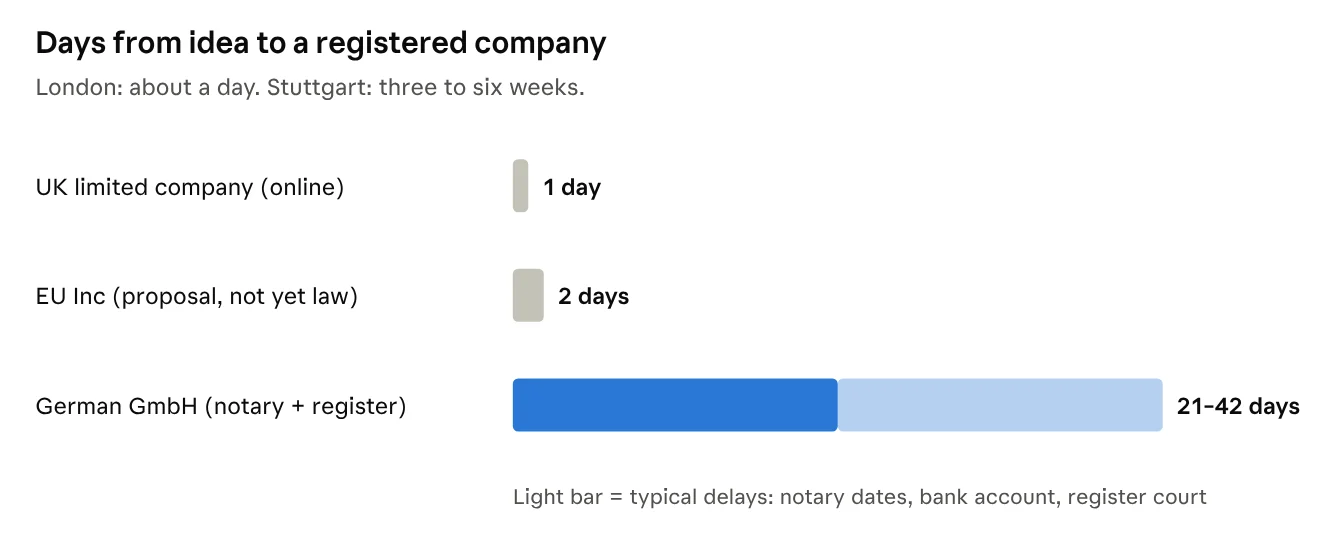
Source: Companies House fees and processing times via UK formation agents (2026); GmbH timelines via German formation guides; EU Inc per the European Commission proposal of 18 March 2026
Brussels knows this hurts. Its EU Inc proposal from March 2026 promises a company in 48 hours, fully online, for less than €100 and with no minimum capital. But it is still a proposal: member states and the European Parliament have to agree a final text first.
Lena is not alone, and that is the problem
While Lena waits for her notary, here is a surprise: Germany used to be a nation of founders. Around 2002 the country saw about 1.5 million business starts a year. In 2025 it was about 690,000.
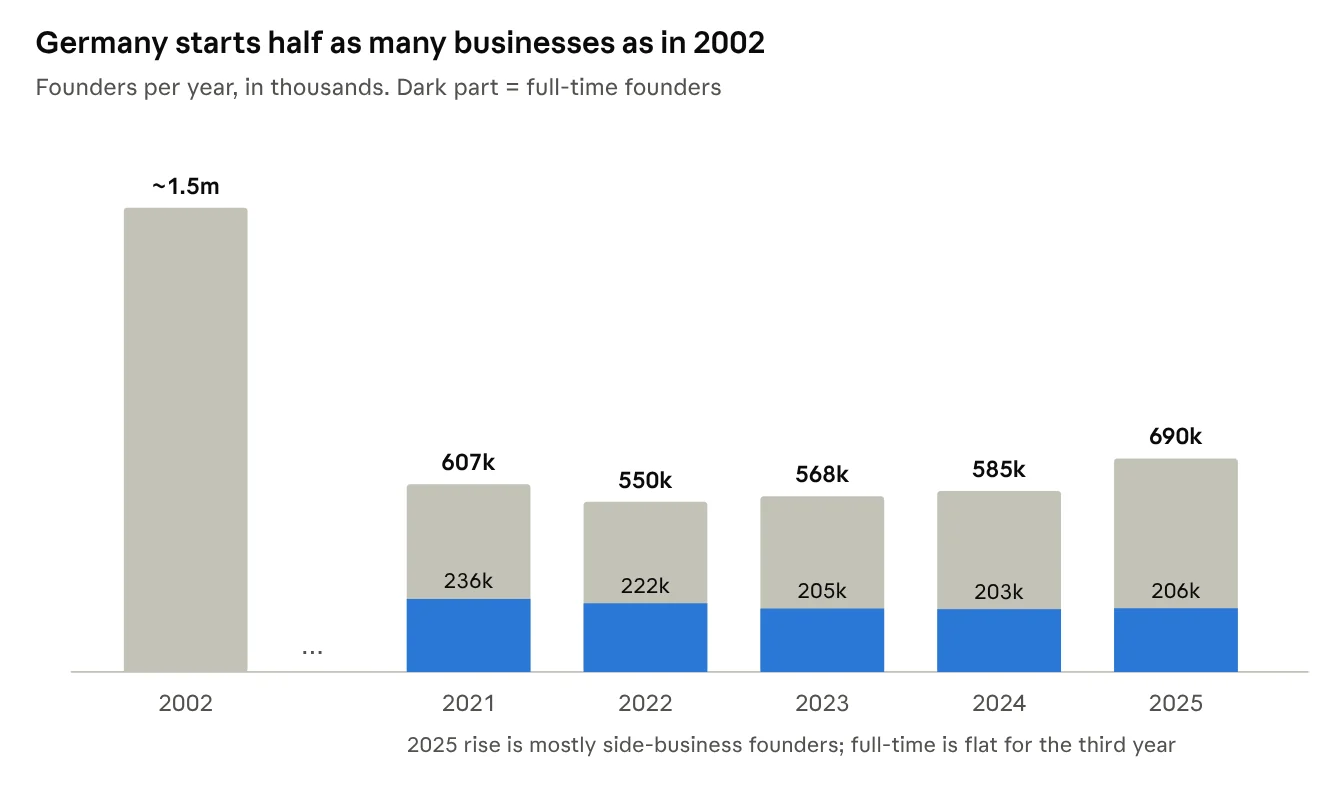
Source: KfW-Gründungsmonitor (KfW Research, 2025 and 2026 editions); 2002 value approximate
The 2025 headline looks good: founders rose 18% in a year. But look at the dark part of the bars. Almost all of the rise came from side businesses, which hit a record 70% share, while full-time founders stayed stuck at about 206,000. KfW's own chief economist blames a tougher job market: people start a little business on the side to earn extra money, not to build the next SAP.
There is good news inside the numbers too. In 2025 about 40% of German founders were under 30, a record, and 34% had an immigration background. The will is there. The system around it is the bottleneck.
Meanwhile, in Austin and London

Jake is part of a stampede. Americans filed 5.67 million new business applications in 2025, the highest number since records began in 2004. Many will never hire anyone, but the sheer energy is real.
Priya has company too. The UK registered about 832,000 new companies in 2025, and its number of active companies hit a record 5.66 million.
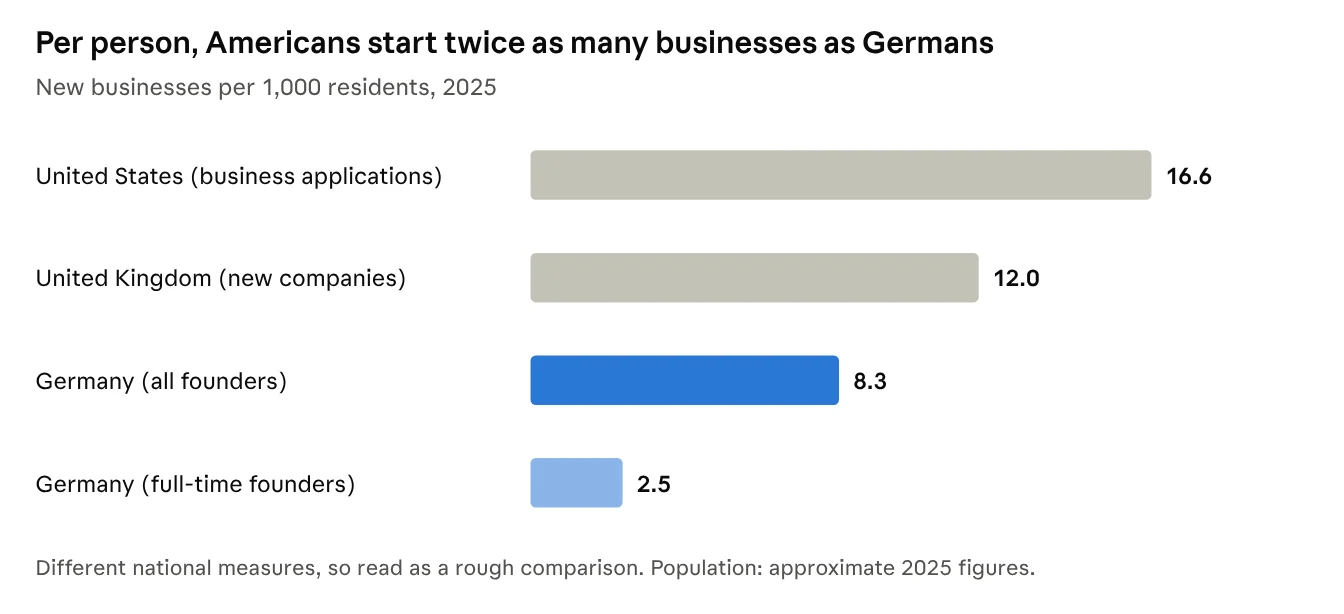
Source: US Census Bureau Business Formation Statistics (5.67m applications, 2025); NatWest/Beauhurst New Startup Index (832,000 UK incorporations, 2025); KfW-Gründungsmonitor (Germany, 2025); per-1,000 rates calculated
Count only people who start a business as their main job and Germany drops to about 2.5 per 1,000 residents. That is the number that builds tomorrow's employers, and it has not moved in three years.
Month three: the money

Lena finally has her GmbH. Now she needs €2 million to hire engineers. Jake needs the same, in dollars. Here is the pond each of them is fishing in.
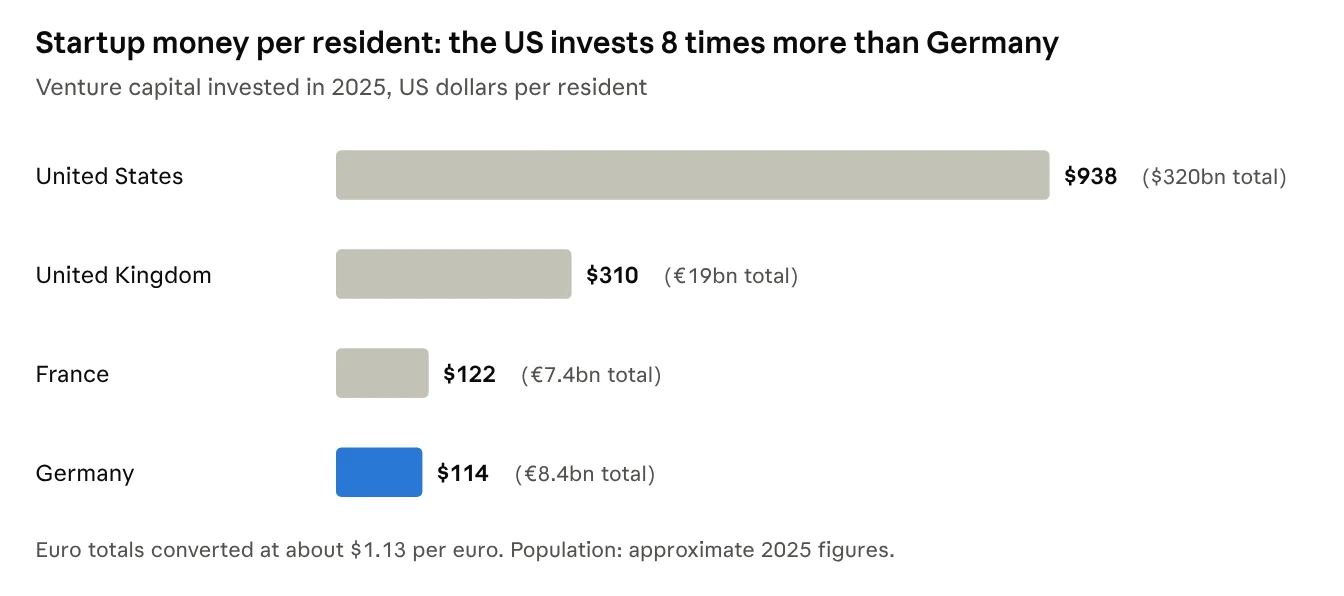
NVCA 2026 Yearbook with PitchBook data (US, $320bn); EY European Start-up-Barometer 2025 (UK €19bn, Germany €8.4bn, France €7.4bn); per-resident figures calculated
US venture firms closed 15,352 deals worth $320 billion in 2025, the second-highest year ever. German startups raised about €8.4 billion, a respectable 19% more than in 2024. The UK, with €19 billion, raised more than Germany and France combined.
The gap is worst exactly when a company tries to grow up. Draghi's report on EU competitiveness put the later-stage funding gap with the US at about 82%. So Lena gets her seed round. Her Series B is where the trouble starts.
Year three: the great escape

Lena's app works. Factories love it. Then an American investor calls with a big cheque and one condition: move the holding company to Delaware.
She would not be the first. Draghi's report looked at 147 unicorns founded in the EU and found that 40 had moved their headquarters abroad: 32 to the US, 7 to the UK and 1 to Israel. The European Commission's own researchers put the share of all VC-backed startups that relocate much lower, at 3.3% to 4.3%. But it is the biggest winners that leave, and US investors often ask for exactly that move.
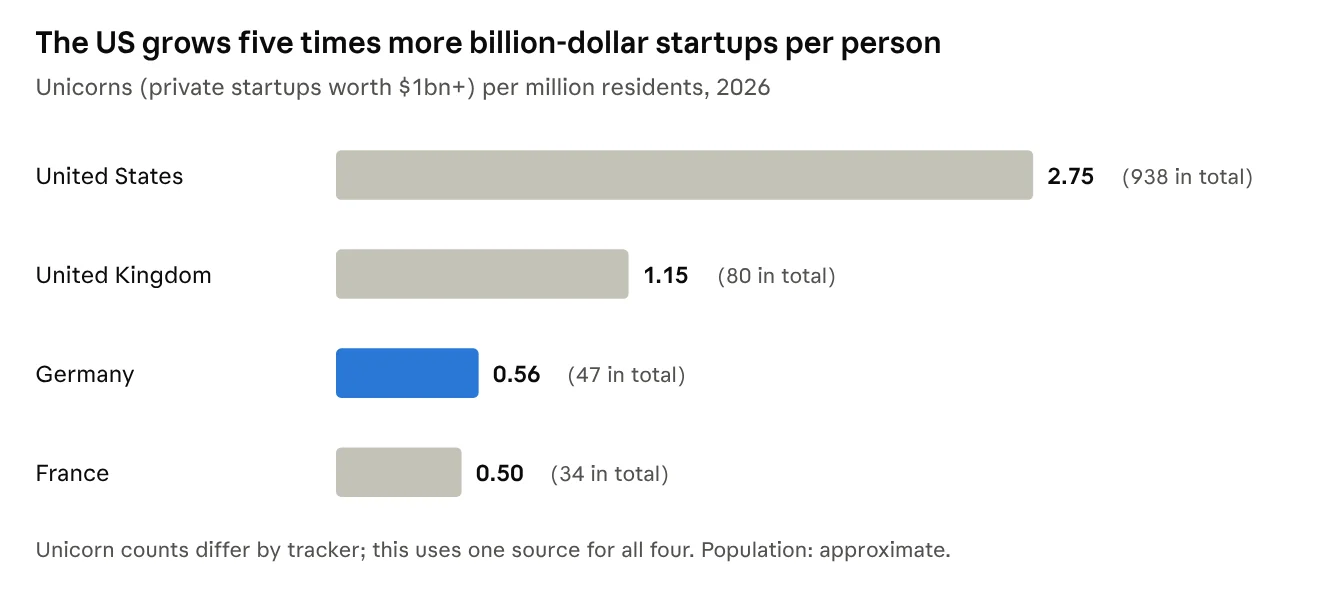
Source: Hurun Global Unicorn Index 2026 as reported by IT Edge News (US 938, UK 80, Germany 47, France 34); per-million figures calculated
Germany is actually the EU's strongest unicorn nation, ranking fifth in the world behind the US, China, the UK and India. That is the frustrating part. The talent is clearly here. The scale is not.
So why does Lena keep running uphill?
It is not that Germans lack ideas. Five things push against them.
Paperwork as a sport. A notary, €12,500 paid in, a register court and a tax office, all before the first invoice. On top of that, Draghi counted around 100 tech-focused EU laws and more than 270 regulators active in digital networks.
The money is there, but it is parked. German pension funds, insurers and foundations manage about €2.8 trillion. European pension funds put only around 0.12% of their assets into venture capital. German VCs estimate that a bigger allocation could unlock about €15 billion a year for growth companies.
27 markets that pretend to be one. Jake launches in one country with one language, one legal system and 340 million customers. Lena's "single market" still means separate company law, tax rules and labour law in every member state.
The economy is not helping. German company insolvencies rose 10.3% to 24,064 in 2025, the highest level since 2014. When big customers are cutting costs, buying from a two-year-old startup feels risky.
Expensive energy. Around half of EU companies call energy costs a major obstacle to investment, about 30 percentage points more than in the US.
Plot twist: it is not all gloom
Before you pack your bags for Texas, some good news.
German startup funding is rising. €8.4 billion in 2025 was the third-highest total in German startup history. Bavarian startups in AI, energy and defence now raise more than Berlin.
Europe is making founders. Atomico's State of European Tech 2025 says almost 60% more people started companies in Europe in 2025 than in 2023.
Brussels finally listened. The EU Inc proposal promises a company in 48 hours, under €100, no minimum capital, valid across all 27 countries. Critics like Allied for Startups say it is still not a true 28th regime, but it is a real start.
Berlin and Paris are going after the parked money. Germany's WIN initiative targets about €12 billion of extra institutional capital for venture, and Germany and France are building a joint platform to channel pension money into European growth funds.
The UK shows Europe can do it. Same continent, same time zone, and twice Germany's unicorns per person. Speed and simple rules matter.
How Lena's story could end

There are two endings.
In the first, Lena takes the Delaware cheque. Her company grows fast, lists in New York, and Germany keeps the engineers but loses the headquarters, the taxes and the next generation of investors her success would have created.
In the second, three things happen. EU Inc becomes law and she opens a company in two days instead of six weeks. German pension money finally flows into a Series B fund at home. And selling to customers in Lyon is as easy as selling to customers in Leipzig. Lena stays, hires 400 people in Stuttgart, and in ten years backs the next Lena herself.
None of this needs Germans to become Americans. It needs the rules to move as fast as the founders do. Germany has the talent, the savings and the industry. What it is missing is speed.
Your turn: if you started a business tomorrow, where would you register it, and why? It is a great question for your next Business English discussion.
Sources
Lena, Jake and Priya are invented characters; all figures come from the sources below. Per-person rates are our own calculations using approximate 2025 population figures.