


An analysis of the ultra-fast-fashion parcel economy, its collision with EU customs policy, and the strategic pivot now underway
Part I — The Golden Days
There was a moment, not long ago, when a teenager in Stuttgart could order eleven items — a crop top, three phone cases, a set of press-on nails, a dog sweater, a keychain, a phone charger, two rings, a mini flashlight, and a pair of sunglasses — pay less for the entire haul than a single T-shirt at a shopping-mall retailer, and have it land on her doorstep within a week, tax-free, duty-free, frictionless. That moment was not an accident. It was engineered.
Shein was founded in 2008 (originally as SheInside) and spent its first decade as an obscure Nanjing-based wholesaler before pivoting, around 2014, into what would become the defining retail model of the 2020s: ultra-fast, algorithmically driven "real-time" fashion, manufactured in small batches of 100-200 units, tested on social media, and scaled only when a design proved it could sell. Temu launched far later — September 2022 — as a project of PDD Holdings, the parent of Chinese shopping app Pinduoduo. It had no fashion pedigree and no brand loyalty to lean on. What it had instead was capital, an aggressive advertising budget, and a ruthlessly simple pitch: "Shop like a billionaire."
Both companies were built on the same three pillars, and understanding them is the key to understanding everything that followed.
1. Consumer-to-Manufacturer (C2M), not Design-to-Warehouse
Traditional fast fashion (think Zara or H&M) still forecasts demand, commits to production runs, and ships to physical stores months in advance. Shein inverted this. Its factories — thousands of small, flexible workshops clustered around Guangzhou — are wired directly into its ordering and social-listening algorithms. A design can go from sketch to a 100-unit test batch to a re-order of thousands within days, guided entirely by real-time sales data. Temu adapted a lighter version of this for a far broader catalogue — electronics, home goods, toys — sourced from thousands of small Chinese manufacturers who upload their entire catalogues directly onto the platform.
2. The De Minimis Engine
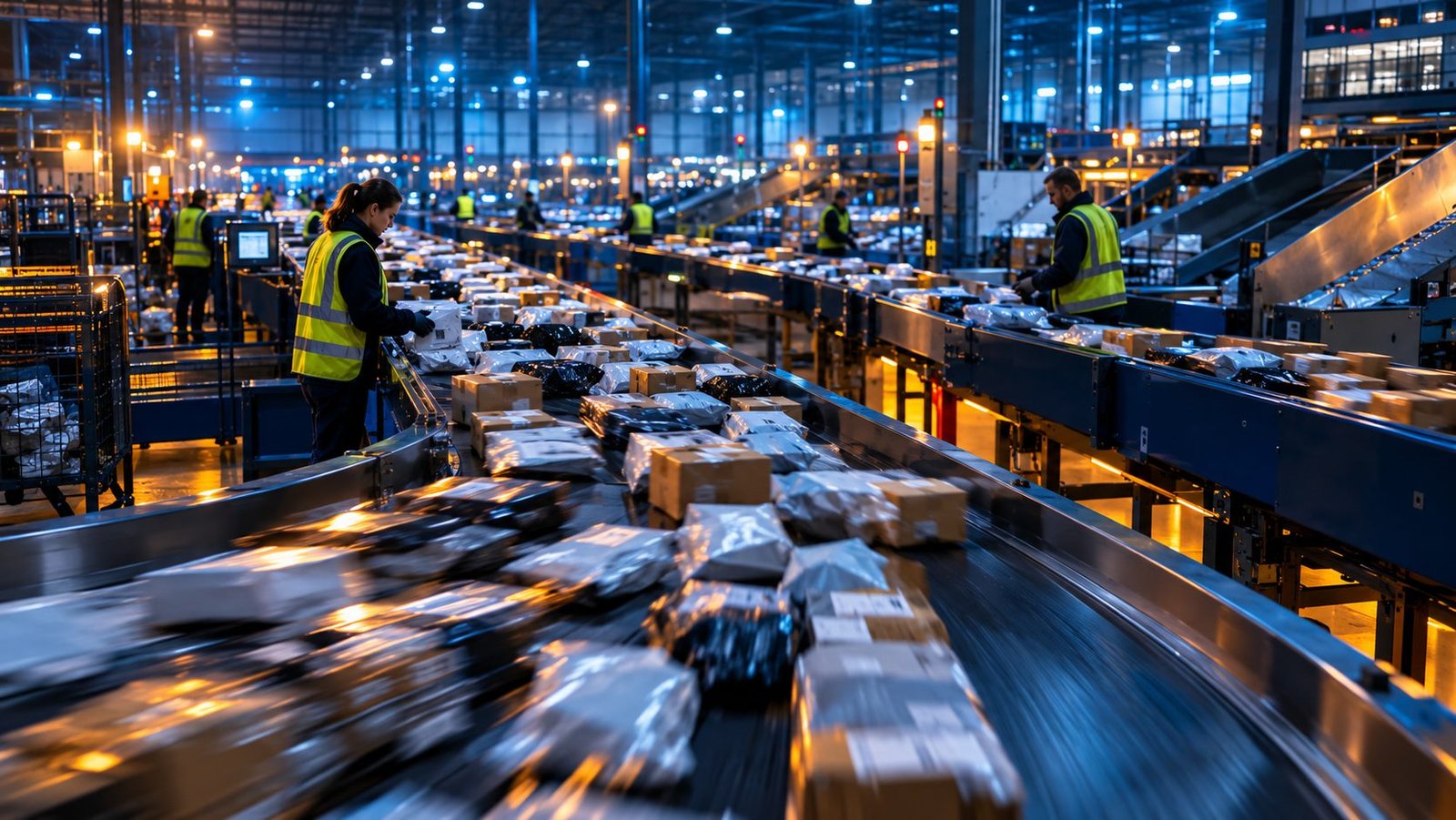
The second pillar was regulatory, not technological, and it is the one now under demolition. For decades, most Western customs regimes exempted low-value parcels from duties and formal customs review — the EU's threshold sat at €150, the US at $800. Shein and Temu did not merely benefit from this exemption; they built their entire logistics architecture around it. Rather than bulk-shipping inventory into regional warehouses (which would trigger duties, VAT and customs declarations), they shipped millions of individual parcels directly from Chinese sorting hubs to individual doorsteps in Paris, Warsaw and Stuttgart — each one, on paper, a separate untaxed, lightly inspected import.
The scale this produced is difficult to overstate. According to European Commission figures, the number of low-value parcels entering the EU under this exemption rose from roughly 1.4 billion items in 2022 to 2.3 billion in 2023 and 4.6 billion in 2024 — reaching an estimated 5.9 billion items in 2025, the equivalent of more than 16 million parcels arriving at the EU's external border every single day.
The Climb: Low-Value Parcels Entering the EU (items valued under €150, in billions)
| Year | Parcels (billions) |
|---|---|
| 2022 | 1.4 |
| 2023 | 2.3 |
| 2024 | 4.6 |
| 2025 | 5.9 |
Figure 1. Low-value parcel imports into the EU exempt from customs duty, 2022-2025. Source: European Commission trade data, cited by Euronews (Aug 2026).
3. Performance Marketing at a Loss
The third pillar was simply spending more on customer acquisition than any rational unit economics would suggest. Temu ran three Super Bowl ads in February 2024 alone, part of a marketing push reported at roughly $3 billion for the year, and briefly out-spent every advertiser except Amazon on Facebook. Analysts estimated Temu was losing on the order of $30 per order at points during this expansion — losses underwritten by the domestic profits of its sister platform, Pinduoduo, in a strategy modeled on subsidizing early-stage hypergrowth until scale and repeat custom made the business self-sustaining.
"Shein took nine years to reach $20 billion in sales. Temu did it in two."
The results, while the model held, were extraordinary. Shein's revenue grew roughly 40% across all of 2023, and the company briefly more than doubled its profits to a reported record above $2 billion, according to a Financial Times account cited by the South China Morning Post. Temu's parent, PDD Holdings, reported total revenue of $54 billion in fiscal 2024 — a 59% year-on-year increase — with net income of $15.4 billion. Temu itself moved roughly $18 billion in total sales across 2023, then blew past that figure in the first half of 2024 alone, reaching an estimated $20 billion in six months. By late 2023, Temu had been downloaded more than 250 million times and was simultaneously the most-downloaded shopping app in fifteen countries, including the United States, United Kingdom, Germany, Japan and Brazil.
For a moment, it looked unstoppable: a business model that had discovered a permanent structural advantage over every taxed, warehoused, duty-paying competitor in the Western retail landscape. It was, as more than one industry analyst put it privately, a balloon — inflating fast, filled with cheap air, and entirely dependent on a border that stayed open.
Part II — The Balloon Pops
Regulators do not move quickly, but they do eventually move. And once the United States acted, the EU's own hand was forced.
The first puncture came from Washington. On 2 May 2025, the US ended de minimis treatment for parcels originating in China and Hong Kong, followed by a global end to the exemption on 29 August 2025 — replacing it with formal customs entry, full duties, and flat per-item charges on postal shipments. The effect was immediate: low-value parcel exports from China to the US fell by roughly 30% on customs-data measures, with some counts of sub-$800 shipments down by more than half. Temu reportedly shut off its US advertising overnight in response.
Brussels had been watching. On 12 December 2025, EU member states agreed to a temporary flat customs fee on small imported parcels, formalising a proposal from EU Trade Commissioner Maroš Šefčovič, who framed it as a matter of "fair competition at our borders in today's e-commerce era." The measure took effect on 1 July 2026: every parcel valued under €150 entering the EU from outside the bloc now carries a flat €3 customs duty per parcel (not per item within it, provided items ship together).
On paper, €3 sounds trivial. In practice, on a typical €30 Temu basket, it functions as roughly a 10% tariff — landing directly on a business model whose entire premise was shaving fractions of a euro off every possible cost. The Commission layered regulatory pressure on top of the tax: on 2 June 2026, it fined Temu €200 million under the Digital Services Act, concluding that the platform had failed to properly assess the risk of illegal and unsafe products reaching EU consumers, after its own mystery-shopping exercise found buyers were highly likely to encounter non-compliant goods. Shein, designated a Very Large Online Platform in 2024, has been under separate formal DSA proceedings since early 2026 over illegal product sales, manipulative design patterns, and recommender-system transparency.
The Pop: Sales Volume Change, June - July 2026 (after the EU's €3 per-parcel customs levy)
| Platform | Change in sales volume |
|---|---|
| Temu | about -50% |
| AliExpress | -37% |
| Shein | about -15% |
Figure 2. Change in platform sales volume, June to July 2026, following the EU's €3 flat customs levy. Source: French customs data cited by Euronews (27 Aug 2026).
The volume collapse was immediate and asymmetric. According to French customs figures cited by the country's economy ministry, the total number of small parcels imported into the EU fell 30-40% in the weeks following the levy's introduction. Between June and July 2026, Temu's sales volumes slumped by roughly 50%; AliExpress fell 37%. Shein held up considerably better, down only around 15% — a resilience regulators and analysts alike attributed to Shein's head start in building EU-based fulfilment, including a new warehouse in Poland that opened at the end of 2025, allowing a growing share of orders to clear customs in bulk rather than as individually taxed parcels.
Consumer sentiment data from the Netherlands, gathered by RTL Nieuws in August 2026, illustrates how the tax interacted with pre-existing doubts rather than creating them from nothing. In that survey, 46% of Dutch respondents said they were ordering less often from Chinese webshops since the levy began — but the underlying dissatisfaction ran deeper than the €3 charge itself: 64% complained about product quality, and 73% said the price-to-quality ratio was simply no longer worth it. The tax, in other words, did not manufacture buyer's remorse. It gave existing buyer's remorse a reason to act on it.
Cracks Beneath the Tax: Dutch Consumer Sentiment, August 2026
- Consumer distrust (value for money): 73%
- Consumer distrust (quality): 64%
- Ordering less often since levy: 46%
Figure 3. Dutch consumer sentiment toward Chinese e-commerce platforms, August 2026. Source: RTL Nieuws survey, reported by IamExpat (19 Aug 2026).
There is a broader financial backdrop worth noting: Shein's own profits had already been sliding before the EU acted. Profits reportedly plunged more than 70% in the first half of 2024 as Temu's aggressive discounting and Zara's competitive repositioning squeezed margins, with revenue growth slowing to 23% from 40% across all of 2023. The EU tax, then, did not strike a business at the height of its powers — it struck one that was already labouring under intensifying competition, just as its regulatory shelter disappeared.
Part III — Reading the Wreckage: Why Temu and Shein Fell Differently
The divergence between Temu's roughly 50% volume collapse and Shein's comparatively contained 15% decline is the single most analytically important data point to emerge from the EU's intervention. Both companies faced an identical €3-per-parcel levy. The gap between their outcomes is explained almost entirely by logistics architecture, not brand strength.
| Factor | Temu | Shein |
|---|---|---|
| Exposure to the per-parcel levy | Near-total — single-item parcels shipped direct from China | Partial — growing share fulfilled from EU warehousing |
| DSA enforcement | Fined €200 million (June 2026) | Formal DSA proceedings since early 2026 |
| Pre-existing margin pressure | Losses subsidised by Pinduoduo | Profits already down >70% (H1 2024) |
The lesson regulators intended to teach — that duty-free, single-parcel importing was an unsustainable arbitrage — landed exactly where intended. But it is worth noting the pattern already visible in the US market a year earlier: rather than shrinking after Washington ended de minimis treatment, both companies redirected. Temu activated forward warehouses inside the US to keep serving demand from domestic stock; both platforms then pivoted growth investment toward Europe — the very market now closing the same loophole behind them. The EU levy, in that light, is not a knockout blow so much as the closing of the last major open door in a multi-year game of regulatory whack-a-mole.
Part IV — What Comes Next: The Strategic Pivot
Neither company is retreating. Both are, visibly and rapidly, becoming something closer to ordinary retailers — which is precisely what regulators wanted, and precisely what threatens the economics that made them extraordinary in the first place.
Three converging pressures — the €3 duty, tightening product-identification and safety requirements, and mounting DSA enforcement — are pushing both platforms toward the same set of adaptations by the end of 2026:
- Local warehousing and bulk clearance. Shein's Poland facility is the template: importing in bulk, paying duties once at the container level, and fulfilling EU orders domestically — exactly what conventional retailers already do, at the cost of the speed and unit-cost advantage that once defined the model.
- Shifting liability onto third-party sellers. Both platforms are leaning further into marketplace models where independent merchants list and ship goods directly, spreading both catalogue breadth and legal exposure — a structure EU regulators have signalled they intend to close by holding platforms responsible regardless of who technically owns the listing.
- Geographic rebalancing. Temu has stated an ambition to cut its reliance on the US market — once 60% of its global gross merchandise value — down toward 30%, spreading growth into Brazil, Europe and other markets where it became the most-downloaded app within a month of launch.
- A slower, costlier, more compliant catalogue. Tighter product-safety inspection (prompted by findings that over 60% of tested low-value imports failed to meet EU standards in a 2025 survey) will likely shrink the sheer volume of ultra-novel, ultra-cheap SKUs that made both platforms feel bottomless.
None of this spells collapse. PDD Holdings remains an enormous, well-capitalised company — $54 billion in 2024 revenue is not a rounding error — and Shein retains brand recognition few fashion retailers can match. But the specific business these two platforms were built to run — duty-free, individually shipped, lightly inspected parcels flown directly from Chinese factories to European doorsteps — is ending as a matter of law, not preference. What replaces it is a normal, taxed, warehoused, regulated retail business, competing on the same terms as everyone else. That is a fundamentally different, and considerably harder, game to win.
Sources
- European Commission trade statistics
- Euronews (1 Jul 2026, 27 Aug 2026, 12 Dec 2025)
- IamExpat / RTL Nieuws survey (19 Aug 2026)
- South China Morning Post (25 Oct 2024)
- European Business Magazine (19 Apr 2026)
- PDD Holdings SEC filings (2024)
- ShopAppy trade analysis (Jun-Jul 2026)
Written by Andrew Yarahmadi, founder of Goinenglish, Stuttgart. You are welcome to use this case study in class with a reference to www.goinenglish.de.