


American politics | After the midterms
Voters have taken Congress away from Donald Trump. What he does with the powers they could not take will shape the last two years of his presidency.
WASHINGTON, DC
On the night of November 3rd, as the returns from Texas made plain what kind of evening it was going to be, Donald Trump did something he has rarely done in a decade at the centre of American politics. He congratulated the other side. In a telephone call to CBS News he offered “congratulations to the Democrats” and said he looked forward to working with them. To another interviewer he said he was “absolutely willing” to accept the result. For a few hours Washington wondered whether it was about to meet a different president.
It took six days to find out. On the morning of Monday November 9th Mr Trump asked his followers on Truth Social whether anybody really believed the election had been honest, and blamed the voting machines. In between, his vice-president had published a post-mortem pinning the defeat on the president’s own war. His chief of staff of nearly two years, the most stabilising figure in his White House, was gone. Her successor was the architect of the administration’s most divisive policy. The price of oil had its steepest weekly fall since the pandemic, and the Dow Jones Industrial Average its best day after a midterm since 1982.
The week is worth dwelling on because it contained, in miniature, the question that will govern American politics until January 2029. A midterm defeat changes what a president can do. It does not settle what he will do. Mr Trump has lost the House of Representatives, the Senate, a majority of the country’s governors’ mansions and, on the evidence of the exit polls, the confidence of nearly two-thirds of the people who voted. He retains the veto, the armed forces, the tariff schedule, the Department of Justice and the largest megaphone in the world. The interesting part is the gap between the two lists.
Higher than a wave
Start with the scale. As counting stood on November 9th, Democrats had won 252 seats in the House, a net gain of 41, with 19 races still to be called. Hakeem Jeffries, the New Yorker who is set to become the first black Speaker when the new Congress meets on January 3rd, says his party will finish with at least 255. The modern record for either party is 257, set by the Democrats in 2009. In the Senate, where the map was supposed to protect Republicans, Democrats flipped seven seats and hold at least 54 of the 100. Alaska and Mississippi are still being counted; Democrats could end with 56.
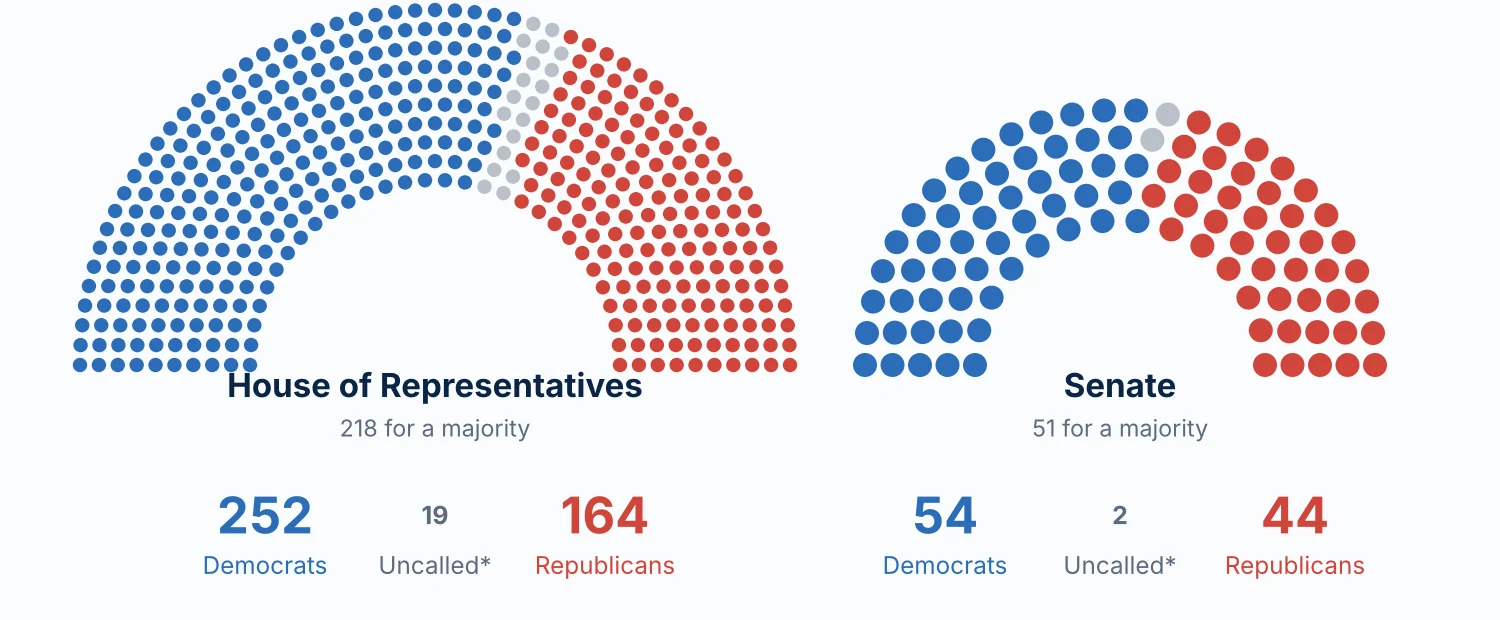
Chart 1. The new arithmetic: United States Congress, seats by party after the midterm elections of November 3rd 2026. Sources: NBC News; Associated Press. Position as of November 9th. *Alaska and Mississippi Senate races and 19 House races not yet called.
The geography was as striking as the arithmetic. James Talarico, a Democrat, won a Senate seat in Texas. Kansas, which had not sent a Democrat to the Senate since the 1930s, did so. Iowa, Ohio, North Carolina, Maine and South Carolina went the same way. Democrats flipped five governorships, including Texas and Ohio, and now hold a majority of them for the first time since 2010. Mr Jeffries, not a man given to understatement on such occasions, called it “an American tsunami”.
Some perspective is in order. Presidents nearly always lose ground at midterms; Mr Trump has said so repeatedly this week, and he is right. Since 1974 the president’s party has gained House seats at a midterm only twice. Barack Obama lost 63 in 2010 and Bill Clinton 52 in 1994. Mr Trump himself lost 40 in 2018. What is unusual about 2026 is not that the pendulum swung but how far it swung on a map that Republicans had spent a year redrawing in their own favour, and that it took the Senate with it.
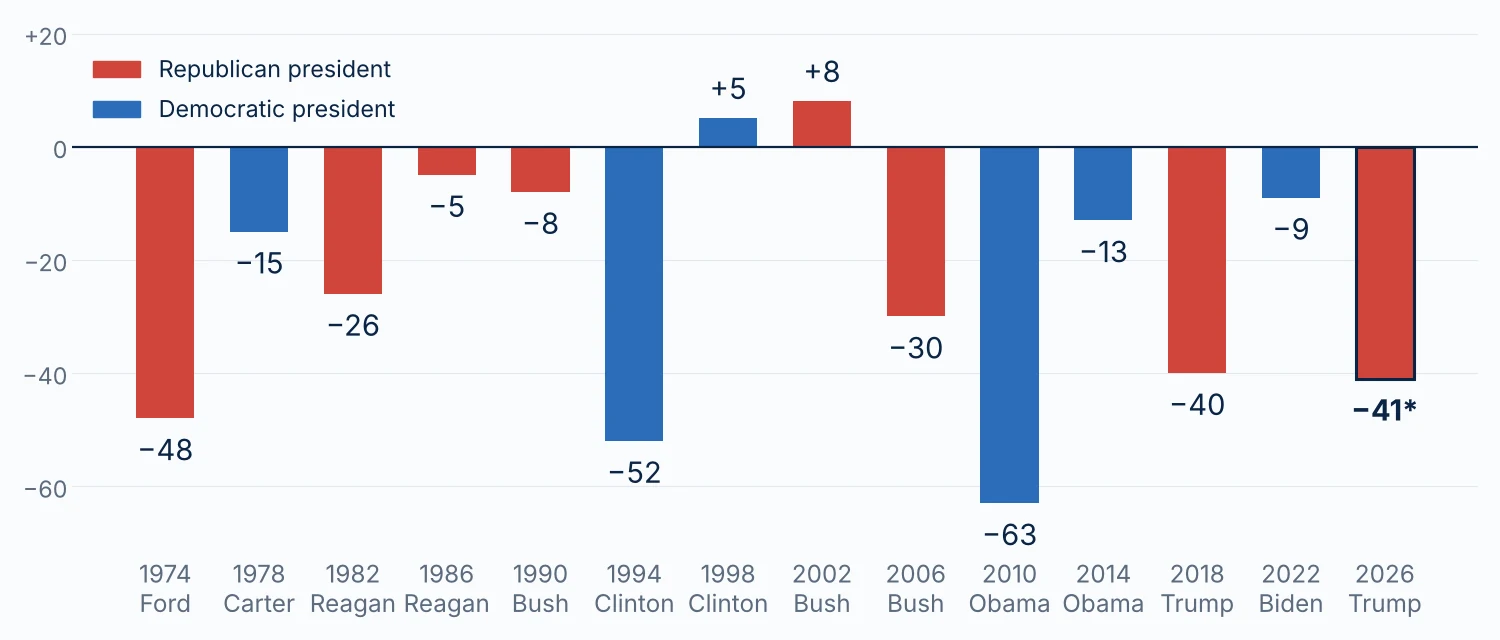
Chart 2. The midterm tax: net change in House seats for the president's party at midterm elections. Sources: American Presidency Project; NBC News. *At least; 19 races uncalled as of November 9th.
Why did it happen? The exit polls offer an answer that is unusually tidy. Some 74% of voters told NBC’s pollsters that the war with Iran was a crucial or major factor in their choice, and those voters broke for Democrats by 62% to 35%. Sixty-three per cent thought military action had been the wrong decision. Three-quarters said the economy was in poor shape, and 65% said the president’s policies had made it worse. Only 37% approved of the job he was doing.
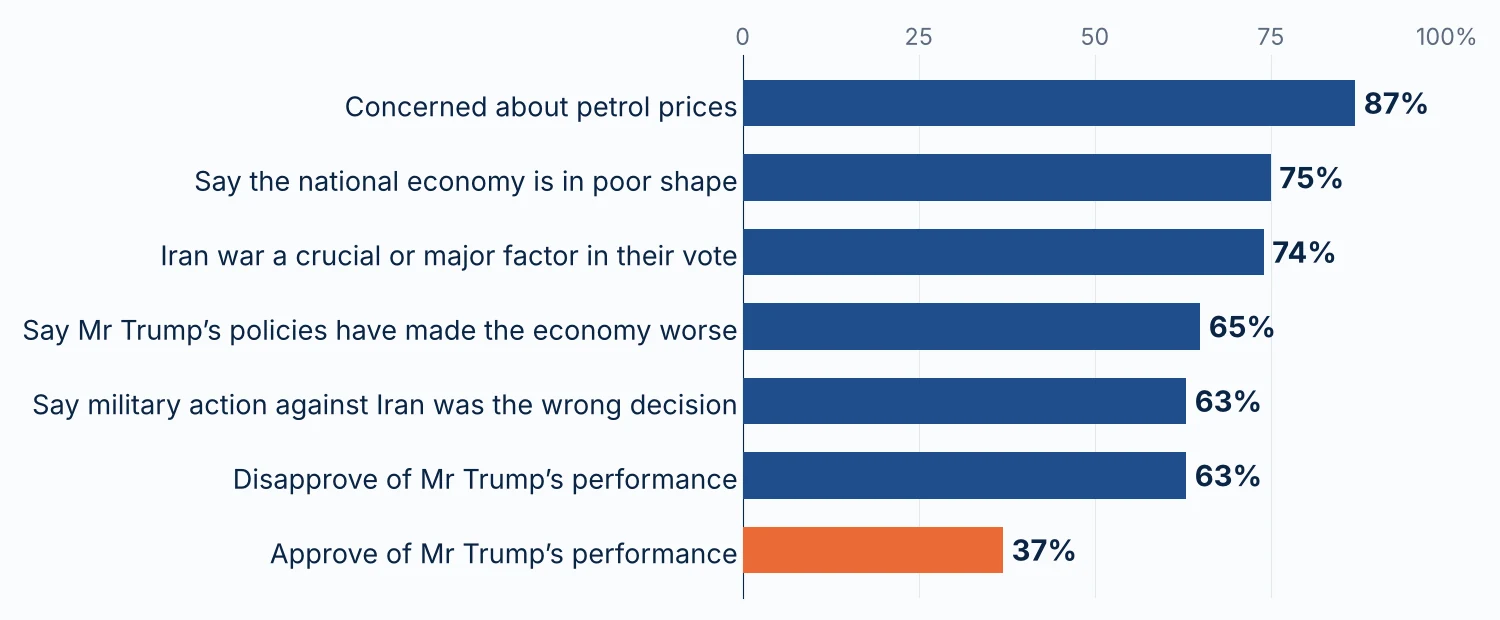
Chart 3. What the voters said: United States, midterm voters, % agreeing, November 3rd 2026. Sources: NBC News exit poll (SSRS); CNN exit poll.
The two complaints are really one. The war, launched alongside Israel on February 28th and sold as a matter of four or five weeks, is now in its ninth month. Iran’s throttling of the Strait of Hormuz, through which a fifth of the world’s oil and liquefied gas once passed, pushed the average price of American petrol from under $3 a gallon to $4.48 by early May; it was still hovering around $4 on polling day. Annual inflation rose from 3.4% in August to 3.7% in September. Voters who had returned Mr Trump to office in 2024 chiefly to bring prices down found themselves paying for a conflict that most of them had not asked for.
The White House’s reading is less damning, and not baseless. The president was not on the ballot. Second-term midterms are historically brutal: the “six-year itch” cost Ronald Reagan, George W. Bush and Barack Obama their Senate majorities too. Mr Trump maintains that stopping Iran from acquiring a nuclear weapon was worth the political price and that he would do it again. He has also suggested that voters simply disliked the candidates. Each of these claims contains some truth. None explains Kansas.
What is lost, and what is left
From January, three things leave the president’s hands. The first is legislation. Nothing reaches his desk without Mr Jeffries and whoever leads the Senate Democrats agreeing to send it. The party-line budget manoeuvre that carried last year’s tax-and-spending law is dead; so is any hope of a second one.
The second is personnel. A Democratic Senate decides which judges, cabinet secretaries, ambassadors and Federal Reserve governors are confirmed. Chuck Schumer, the current Democratic leader, has already said that his side will not confirm a conservative nominee to the Supreme Court should a vacancy arise, and declined to say whether a seat would be left empty until after the 2028 election. Pressure had been growing on the court’s two oldest conservatives to retire while Republicans could still choose their successors. That window closes in eight weeks.
The third, and the one presidents tend to underestimate, is immunity from scrutiny. For two years congressional committees have asked the administration few awkward questions. Their new chairmen will have subpoena power and a long list: the Jeffrey Epstein files, the conduct of the deportation campaign, the finances of the president’s family, and the planning of the war. Democrats promise that these inquiries will begin at once.
Democrats can stop almost anything. Without the president, they can start almost nothing.
Now the other column. To override a veto takes two-thirds of each chamber: 290 votes in the House and 67 in the Senate. Even on the most generous projections Democrats will fall more than 20 short in the House and 11 short in the Senate. Mr Trump knows it. On election day he posted a picture of a red cap bearing the word “VETO”. The same arithmetic protects him from removal. The House can impeach by simple majority; conviction in the Senate would require at least 11 Republicans to turn on their own president.
Much of what Mr Trump has done since January 2025 was never legislation in the first place. The immigration crackdown runs on executive authority and money already appropriated. Tariffs rest on statutes passed decades ago. The war was begun without a vote of Congress. His advisers have been reminding him of this all week. The honest summary of the new balance is that Democrats can stop almost anything and start almost nothing, while the president can start a good deal but will find it harder to finish.
The one great exception is money. Congress writes the budget, and the government’s current funding runs out on December 11th. The outgoing Republican majority may patch that deadline, but every spending bill after January 3rd will be drafted by Democrats. A president can veto a budget; he cannot write one. That is where the leverage on the war, on health care and on immigration enforcement really lies, and it is where the confrontations of 2027 are likeliest to come.
The first moves
How a president responds to a rebuke tends to reveal itself in personnel. George W. Bush dismissed his defence secretary the day after the “thumping” of 2006. Mr Trump sacked his attorney-general the day after the 2018 midterms. Mr Clinton, after 1994, hired a strategist who taught him to split the difference with a Republican Congress, and was comfortably re-elected.
Mr Trump’s first move pointed the other way. On Friday November 6th he announced that Susie Wiles, his campaign manager in 2024 and chief of staff since inauguration day, would move to his political operation. Stephen Miller, the deputy who designed the deportation drive, took over on Monday. Ms Wiles had intended to stay through the end of the year, according to people close to her; the president brought the date forward. She was widely credited with ending the leaks and staff churn of his first term.
There are two ways to read the appointment. Critics, including a handful of Republican congressmen from the Midwest, see a president promoting the face of the agenda that voters had just rejected. Allies see a president who expects two years of subpoenas and vetoes and wants a chief of staff built for combat rather than conciliation, one who already knows where every lever is. Both readings can be true. What the choice plainly is not is a turn towards the centre.
Other signals have been mixed, sometimes within a single day. On election night Mr Trump said the result had nothing to do with his cabinet and that he planned no changes. By Sunday, on CBS’s “60 Minutes”, there would be “maybe a few changes”. He is reported to be asking advisers whether Pete Hegseth, the defence secretary, should stay. A Republican congressman, Thomas Massie of Kentucky, intends to force a vote on impeaching Mr Hegseth this week, and Mr Jeffries has said he supports the resolution. If the president wants a new defence secretary confirmed by a friendly Senate, he has until January 3rd.
Meanwhile Todd Blanche, the attorney-general, has said that Democratic lawmakers could themselves face investigation over what he called threatening rhetoric. And then came Monday’s post about the machines. It may be venting. It may be the opening of an argument that the incoming Congress is illegitimate, which would sour everything that follows. The president’s own officials, notably, have not echoed it.
The war comes home
The most consequential decision in front of Mr Trump is not about staff. It is about Iran, and here the election may already have changed his mind.
On the morning after the vote J.D. Vance, the vice-president, broke a long public silence. “The reason we lost is the war,” he wrote, and went on to list what he said disaffected Trump voters wanted: an end to the conflict, attention to the cost of living, America first, and a changed relationship with Israel. It was a remarkable thing for a sitting vice-president to publish. More remarkable was the response. Mr Trump called the assessment largely true, said he had told Mr Vance to write what he felt, and had the White House’s own account circulate the post.
Before the election the president had hinted several times that fresh strikes might follow it. Advisers were debating a final blow to bring the conflict to a decisive end. By Sunday he was telling CNN that renewed war was “highly unlikely” so long as talks progressed. On Monday the prime minister of Qatar arrived at the White House, reportedly carrying an Iranian offer: Tehran would reopen the strait and drop its demand to levy tolls on shipping; America would lift its naval blockade and release $8bn of frozen funds. A Qatari official disputed the details, and American and Gulf officials caution that no breakthrough is imminent. Iran still refuses to put its nuclear programme on the table, which was the stated point of the war.
Markets have not waited for the small print. Brent crude fell by 16% in election week and by a further 5% on Monday, to around $93 a barrel. That is still a third above its pre-war level, and tankers are still being attacked near the strait. Goldman Sachs, for one, thinks the relief premature and has raised its year-end forecast.
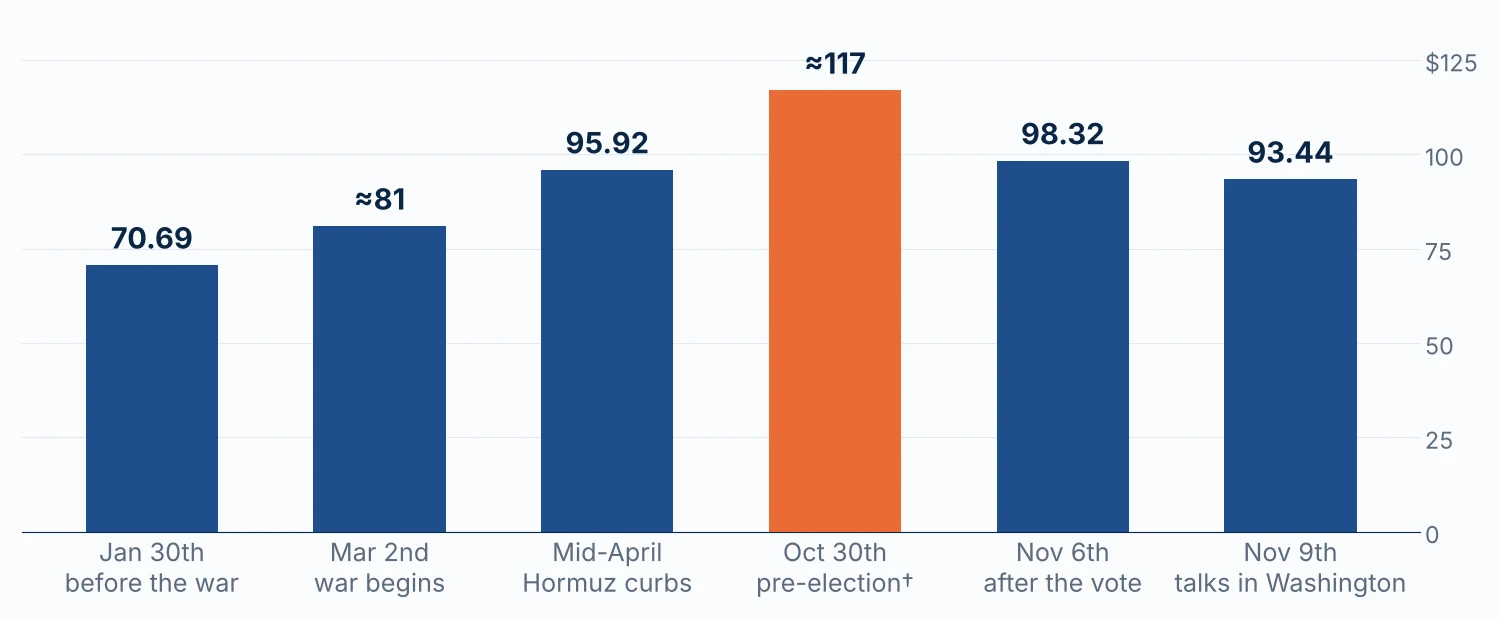
Chart 4. A war premium, deflating: Brent crude oil, $ per barrel, selected dates in 2026. Sources: Reuters; press reports. †Approximate, implied by the reported 16% fall in the week to November 6th.
The incentives, though, have shifted. Until last Tuesday the political cost of the war was a forecast; now it is a number. From January a Democratic Congress will control the Pentagon’s budget and has promised to use it. The annual defence-policy bill, which must pass in the lame-duck session, is already becoming a vehicle for Republican doubters. One adviser has told reporters that the president feels he was misled about how the campaign would unfold. A president who believes that, and who has a deal within reach, has every reason to take it before his opponents can claim to have forced him. A deal that leaves Iran’s nuclear work untouched, however, would invite the charge that eight months of war and $4 petrol bought very little. That is the trap he is in.
Until last Tuesday the political cost of the war was a forecast. Now it is a number.
Gridlock, priced in
Wall Street’s verdict was swift. On Wednesday November 4th the Dow rose by 1,569 points, or 3%. The S&P 500 gained 1.6%. The dollar slipped; the Mexican peso and the Canadian dollar, both sensitive to American trade policy, strengthened. Shares in defence contractors and oil producers fell on hopes of peace. Hospital groups rose on the prospect that cuts to public health programmes might be reversed, and drinks companies battered by tariffs rose on hopes of relief.
The logic is the familiar one that markets like divided government, because it narrows the range of things that can happen. As one strategist at Deutsche Bank put it, the result should act as a brake on extreme outcomes. But the cheerful first reading deserves three qualifications.
The first is that gridlock constrains Congress, not the president. Tariffs are the clearest case. In February the Supreme Court ruled, by six votes to three, that the emergency-powers law Mr Trump had used for his broadest levies did not authorise them; the Treasury has since refunded some $145bn to importers. The administration simply changed statutes. Duties imposed on national-security grounds remain on cars, steel and much else. In July new levies of 10% or 12.5% were placed on 60 economies under a different trade law. By one estimate tariffs still cover about 54% of American goods imports and cost the average household $800-1,100 a year.
Democrats campaigned on ending them. They cannot. A repeal bill would need 60 votes to clear the Senate and then two-thirds of both chambers to survive a veto. What the new majority can do is hold hearings, squeeze the agencies’ budgets and wait for the courts, which remain the only check with teeth. Businesses planning for 2027 would be wise to assume the tariff wall stays roughly where it is.
The second qualification is that divided government in the Trump era has not, historically, meant calm. The last time he faced a hostile House, in 2018, the result within weeks was a 35-day government shutdown, the longest on record. The fiscal collisions ahead are easy to list. Democrats’ 100-day plan would reverse cuts to Medicaid and food assistance and extend health-insurance subsidies, all of which the president has promised to veto. He, in turn, needs their signatures on every spending bill. Neither side has much reason to blink first, and a government that cannot agree on a budget while fighting a war is not obviously a bullish proposition.
The third concerns the sector that has been carrying the stockmarket. Shares in chipmakers and other firms tied to artificial intelligence swung wildly after the vote, on worries that newly Democratic statehouses, in Texas above all, might slow the construction of data centres. Congress will now hold hearings on the industry’s power consumption and market concentration. Hearings are not laws. But a boom that has been priced for perfection is sensitive to mood.
Then there is the Federal Reserve, which matters more to the economy than anything Congress is likely to pass. Kevin Warsh, the chairman Mr Trump himself installed, raised interest rates in September for the first time in more than three years, to a range of 3.75-4%, and held them there in October while vowing to deliver price stability with “no ifs, ands or buts”. A Democratic Senate will now vet any further appointments to the Fed’s board. One analyst told Reuters that a stronger perception of central-bank independence could, at the margin, support the dollar. The irony is plain: the election has made it harder for the president to get the cheaper money he wants, at exactly the moment he most needs the economy to improve.
The succession starts early
Mr Trump cannot run again, and that fact colours everything. Mr Clinton triangulated after 1994 because he faced re-election two years later. A term-limited president has no such discipline. His incentives run instead towards legacy, towards loyalty and towards the fortunes of whoever inherits his movement.
That contest has begun sooner than the president would have liked. Mr Vance’s post was a diagnosis, but it was also a manifesto: a pitch to the voters who backed the ticket in 2024 and stayed at home or defected in 2026, built around restraint abroad and prices at home. That the president blessed it rather than punished it says something about the weakness of his position. He conceded on Sunday that many in the party had disliked it.
Congressional Republicans are recalculating as well. Mike Johnson, the Speaker, will not seek to lead his party in the minority. The dozens of Republicans who lost their seats owe the president nothing in the lame-duck weeks, and some who survived have concluded that distance is the safer policy. For a decade Mr Trump’s grip on his party rested on the belief that crossing him was fatal. A president who has just cost his party both chambers, and who will never again appear on a ballot, is a less frightening proposition.
It would be a mistake to write him off. Sixty-three per cent disapproval among midterm voters still leaves a large, devoted minority, concentrated in Republican primaries. He will keep the power to end careers on his own side long after he has lost the power to pass laws. And the lame-duck session gives him one last stretch of unified government: Senate Republicans are racing to confirm 23 pending judges before the gavel changes hands.
The winners’ curse
Democrats have problems of their own, of the kind that only success creates. A majority this large contains multitudes: members from districts Mr Trump carried by double digits two years ago, alongside a handful of democratic socialists. Mr Jeffries says no member has raised impeaching the president with him, and he would plainly like to keep it that way, since the Senate arithmetic makes conviction a fantasy and Mr Trump himself predicted in January that a Democratic Congress would try. The pressure from the party’s activists will not go away. Impeaching cabinet officers may prove the compromise.
In the Senate, an effort is under way to draft Chris Van Hollen of Maryland to challenge Mr Schumer for the leadership, on the theory that a new era deserves a new face. Mr Schumer, who can fairly claim to have delivered what he calls “a durable majority”, is expected to survive. The episode is nonetheless a reminder that a party united by opposition discovers its disagreements when handed power.
The deeper risk is one of expectations. Democrats told voters they would end the war, cut prices and scrap the tariffs. From January they will hold both chambers and be able to do none of those things on their own. Bills will pass and be vetoed. If petrol is still dear next summer, the party will have to explain to an impatient electorate the difference between controlling Congress and governing the country. Presidents have won that argument before: Harry Truman ran against a “do-nothing” Congress in 1948 and gained 75 House seats. Mr Trump is not on the ballot in 2028. His party is.
Three roads
The next two years could plausibly take one of three shapes.
In the first, Mr Trump becomes the dealmaker he has always claimed to be. He settles with Iran, lets oil fall and takes the credit; trades a tariff reduction or an extension of health subsidies for something he wants; and leaves office with inflation subsiding and his party competitive. He told CNBC last week that he could work with Democrats on far more than people imagined. There is precedent for presidents finding their footing after a drubbing. There is less precedent for this president doing so, and the promotion of Mr Miller is hard to square with it.
In the second, he governs against Congress rather than with it: by executive order, emergency declaration and veto, with every dispute ending in a courtroom. Shutdowns become routine, investigations are met with counter-investigations, and questions about the legitimacy of the 2026 vote harden into doctrine. This is the path that Monday’s post and Mr Blanche’s remarks point towards. It would be noisy rather than paralysing, because so much of the agenda never needed Congress. Its chief economic cost would be uncertainty, and its chief political cost would fall on the Republican who must run in 2028.
The third is the likeliest, because it is the pattern of the past week: both at once. Conciliation on Tuesday, the machines on Monday. A peace overture to Tehran and a combatant in the chief of staff’s office. Mr Trump has never been a strategist of the long game so much as a tactician of the next news cycle, and a president with no election left to fight has little reason to change.
What can be said with confidence is narrower. The war is likelier to end than it was a week ago. The tariffs are not. The legislative phase of this presidency is finished, and the investigative phase is about to start. And the man at the centre of it, who warned his party in January that defeat would lead to very bad things, must now decide which of them he is prepared to live with. Americans took something from him on November 3rd. They will spend the next two years discovering how much they left. ■
Notes and sources. Seat totals are as reported on November 9th 2026 and will change as the remaining races are called. Election results: NBC News, Associated Press, CBS News. Exit polls: NBC News (SSRS), CNN. Reaction and personnel: CBS News, CNN, The Hill, NPR, Washington Post, ABC News, Axios, Al Jazeera, Time, CNBC. Markets and oil: CNN, Reuters, RTÉ, The National. Economy and trade: NBC News, CNBC, Cato Institute, Congressional Research Service, Baker McKenzie, The Center Square. Historical midterm figures: American Presidency Project. The petrol price on polling day is approximate. Scenarios in the final section are analysis, not forecasts.
Written by Andrew Yarahmadi, founder of Goinenglish, Stuttgart. You are welcome to use this case study in class with a reference to www.goinenglish.de.