


Flight Shame and Corporate Climate Targets
“Can Companies Fly Their Way to Net Zero?”
60-minute lesson. Skills: Speaking, Vocabulary, Reading, Grammar.
Grammar focus: Inversion After Negative Adverbials, Participle Clauses
Let's agree on the next steps by Friday.


1Warm-up Questions (Discussion)
- Should individuals or companies carry the main responsibility for reducing travel emissions?
- Is it hypocritical for a company to promote sustainability while its executives fly frequently?
- How credible are sustainable aviation fuels as a solution?
- Would you accept a longer journey for the sake of the climate? Under what conditions?
2Vocabulary Exercise – Match the Words
Match the words (1–8) with their correct definitions (A–H).
- Flight shame
- Sustainable aviation fuel
- Abatement
- Non-CO₂ effects
- Signalling
- Modal shift
- Science-based target
- Cost-benefit analysis
- A.Actions taken to communicate values or intentions to others
- B.A change from one form of transport to another
- C.An emissions goal aligned with what climate science says is necessary
- D.A feeling of guilt about the environmental impact of flying
- E.A comparison of the costs and advantages of a decision
- F.The reduction of something, especially pollution
- G.Climate impacts of aviation beyond CO₂, such as contrails
- H.Jet fuel produced from renewable or waste sources rather than fossil oil
3Fun Vocabulary Exercise – Agree, Disagree, or It Depends
Decide whether you Agree (A), Disagree (D), or think It Depends (ID). Support your view with an example.
- Flight shame is an effective tool for changing corporate behaviour.
- Sustainable aviation fuel will make the debate unnecessary.
- Executives should lead by example and give up short-haul flights first.
- Corporate travel restrictions are mostly symbolic signalling.
- A modal shift to rail is only realistic if governments invest massively in infrastructure.
4Reading Article
Grounded Ambitions? Corporate Travel in a Carbon-Constrained World
The Swedish word flygskam, or flight shame, entered international vocabulary around 2018, describing the growing unease many people felt about the climate impact of flying. Initially a consumer phenomenon, it has since found its way into boardrooms. Companies that have set science-based targets increasingly recognise that business travel, though often a modest share of total emissions, is highly visible and comparatively easy to reduce.
The case for curbing corporate flights rests partly on physics. Aviation is unusually difficult to decarbonise: aircraft require energy-dense fuels, fleets are replaced slowly, and the industry’s climate impact is amplified by non-CO₂ effects, notably contrails, which many scientists believe roughly double its warming effect, although estimates remain uncertain. Sustainable aviation fuel offers a partial solution, but current production covers only a tiny fraction of demand and is considerably more expensive than kerosene. In the short term, the most reliable form of abatement is simply to fly less.
Corporate responses vary considerably. Some firms have introduced internal carbon prices, so that the climate cost of a trip appears on the department’s budget. Others mandate rail travel below a certain distance or require senior approval for flights. Proponents argue that such measures not only reduce emissions but also encourage a broader modal shift, signalling to rail operators and policymakers that demand for high-quality train connections exists.
Sceptics question both the impact and the motives. Business travel accounts for a small share of global aviation, and leisure flights are growing faster. Restricting employees’ travel while promoting a green image may amount to little more than signalling, especially if the company’s core products remain carbon-intensive. Moreover, a rigorous cost-benefit analysis might reveal that certain trips, such as those that secure major contracts or prevent costly misunderstandings, generate value that far outweighs their emissions.
There are also questions of fairness and culture. Restrictions that apply equally on paper may weigh more heavily on employees based in regions with poor rail links, or on those with caring responsibilities who cannot spend extra nights away. Conversely, if exemptions are granted too generously, senior staff may continue to fly while junior employees face the restrictions, undermining the credibility of the policy.
The emerging consensus among climate-conscious firms is that the objective is not zero travel, but purposeful travel. Fewer, longer trips that combine several meetings, a clear default for rail on suitable routes and transparent reporting appear to deliver meaningful reductions without sacrificing essential relationships. Whether this becomes the norm will depend less on flight shame than on whether companies are prepared to treat travel emissions as a real cost rather than an afterthought.
5Grammar Exercise 1 – Inversion After Negative Adverbials
Rewrite the sentences starting with the words given.
- Companies have never faced such pressure to cut travel. → Never …
- We only realised the true cost after introducing a carbon price. → Only after …
- Employees should not fly for trips under 500 km under any circumstances. → Under no circumstances …
- The policy reduced emissions and improved employee wellbeing. → Not only …
- The firm had barely announced the policy when exemptions were requested. → Barely …
6Grammar Exercise 2 – Participle Clauses
Combine the sentences using a present or past participle clause.
- The company introduced a carbon price. It reduced flights by 40 percent.
- The policy was criticised as symbolic. It was revised the following year.
- She travelled by night train. She arrived rested for the meeting.
- The report was published in March. It revealed a sharp increase in travel.
- Managers realised the impact. They cancelled several conference trips.
7Case Study & Role Play – The Board Decision
Situation
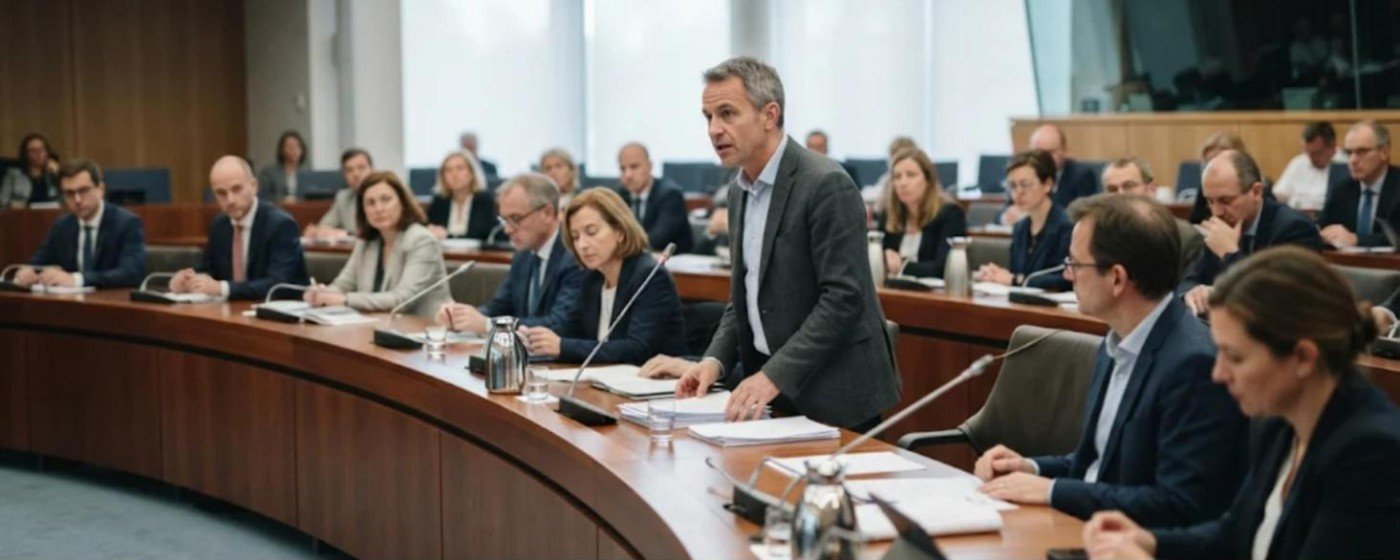
A DAX-listed technology company has committed to a science-based target. Business travel accounts for 18 percent of its reported emissions. The sustainability committee proposes an internal carbon price of €150 per tonne on all flights and a ban on flights where rail takes under five hours. The board must decide.
Group Roles (4 Groups)
Group 1 – Chief Sustainability Officer
- Presents the climate science and reporting obligations
- Argues for meaningful, not symbolic, measures
- Defends the internal carbon price
Group 2 – Chief Revenue Officer
- Warns about losing international clients
- Presents a cost-benefit analysis of key trips
- Proposes exemptions for strategic accounts
Group 3 – Employee Representatives
- Raise fairness issues for regional and caring staff
- Demand equal rules at every level
- Support better rail and hybrid options
Group 4 – Supervisory Board Members
- Assess reputational and financial risks
- Challenge every group’s assumptions
- Vote on the final proposal
Task
- Each group prepares a two-minute statement and three arguments.
- Hold a 15–20 minute board discussion.
- The board votes and explains its decision, including any amendments.
© Goinenglish. Free for classroom and self-study use with this notice. www.goinenglish.de
Train this topic with a real trainer.
Goinenglish runs Business English courses for companies, in-company and online.
More C1 exercises


The Four-Day Week – Rethinking Productivity and Time
The forty-hour, five-day week is often treated as a natural law, but it is a relatively recent invention.


Algorithmic Management – Who Is Really in Charge?
For most of industrial history, monitoring was something done by people: foremen, supervisors and managers who observed, judged and occasionally intervened.

Regulating Childhood Online – Bans, Design Duties and Digital Rights
Concern about the effects of new media on young people is not new.